Reasoning Rhetorically in the Age of AI By Jennifer Fletcher What is human reasoning? What does it mean to be a human, reasoning? These are some of the questions participants will explore in an online course being offered this spring by the National Writing Project as part of its series on teaching argument writing. I’mContinue reading “New NWP Online Course!”
Mentions Archives
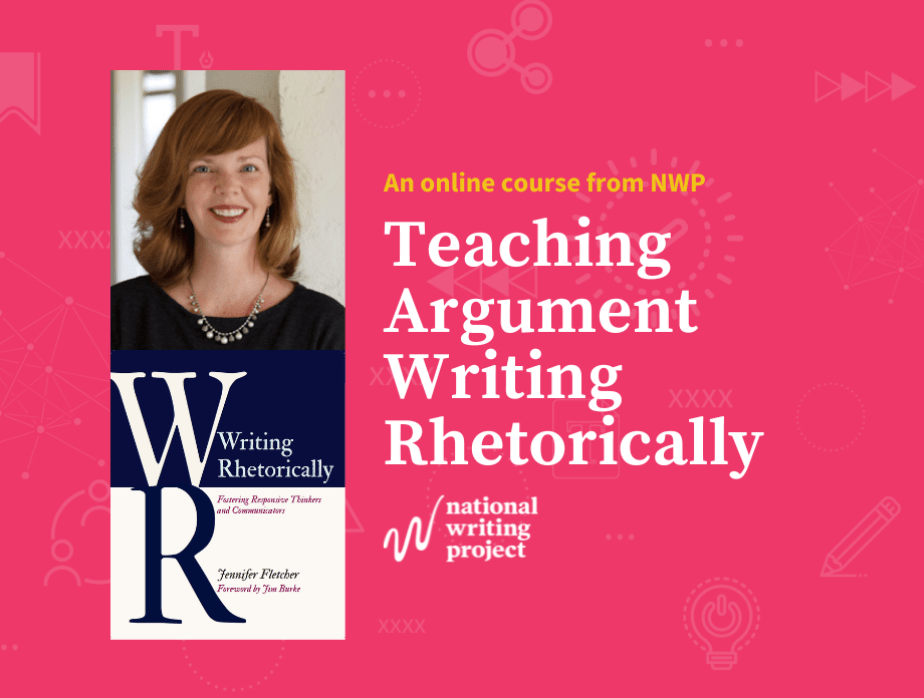
New Online Course! Teaching Argument Writing Rhetorically

By Jennifer Fletcher This spring, I have the honor of facilitating an online course for the National Writing Project as part of its series on teaching argument writing. I have long been an admirer of everything NWP does, so this is a special treat for me. I feel like I’m among friends whenever I’m withContinue reading “New Online Course! Teaching Argument Writing Rhetorically”
Paraphrase and Summary: Getting the “They Say” Right

By Jennifer Fletcher In other posts (see here and here), I’ve written about the value of dialogic argumentation as a mainstay of intellectual work. This is the “they say, I say” approach to source-based writing described by Gerald Graff and Cathy Birkenstein in their popular little book by the same name. Understanding and responding toContinue reading “Paraphrase and Summary: Getting the “They Say” Right”
How Ethos Impacts Pathos: A Tale of Two Writers

By Jennifer Fletcher It was the best of times, it was the worst of times…or, at least, so we would have to believe to accept the arguments of both Martin E. P. Seligman and Barbara Ehrenreich on the topic of American life in the early 21st century. Seligman is the author of such books asContinue reading “How Ethos Impacts Pathos: A Tale of Two Writers”
Writing Thesis Statements as Enthymemes

By Jennifer Fletcher In my new book Writing Rhetorically, I share one of my favorite quotations from rhetoricians Edward P.J. Corbett and Rosa A. Eberly: “Reasoning, by itself, will not get the potatoes peeled” (1). It takes humans in communication with other humans to accomplish real work in the world. When we reason rhetorically, weContinue reading “Writing Thesis Statements as Enthymemes”
Diction Design

By Jennifer Fletcher Did you ever watch the television show Project Runway on Bravo? If so, do you remember the accessory wall with its array of shoes, belts, and handbags suitable for a variety of occasions? Style mentor Tim Gunn always encouraged the fashion designers competing on the show to use the range of available accessories “thoughtfully.” Writers also needContinue reading “Diction Design”
A Claim by Any Other Name

By Jennifer Fletcher In an outstanding webinar I recently attended on rhetorical modes, the presenters explained that “modes” are text structures, text types, or organizational patterns. “Why do we do that?” one participant asked, “Why do we have so many different names for the same thing in English language arts? Wouldn’t it be easier ifContinue reading “A Claim by Any Other Name”
Resurrecting Dead Words

By Jennifer Fletcher In Teaching Arguments, I write about an activity I used for many years with my high school and college students: dead word funerals. I first learned about “dead words” when I was a student teacher back in the mid-nineties. At the time, it seemed like a clever and fun way to teachContinue reading “Resurrecting Dead Words”
The Bias Against Bias

By Jennifer Fletcher Students sometimes feel like they can pull a mic drop on other writers by calling them out for their bias. Labeling a writer “biased” is an ethos slam. One Oxford English Dictionary definition describes bias as “prejudice.” Another mentions “slanting” or “distortion.” It’s hard to read for understanding once you’ve decided a text is prejudiced orContinue reading “The Bias Against Bias”
What Do You Do When You Don’t Know What to Do?

By Jennifer Fletcher This past year forced me to walk the walk in my life as a teacher of rhetorical literacy skills. After all, rhetoric is the art of adaptation. Me thinking “I don’t know how to do this” or “I’ve never done this before” is an almost daily occurrence these days. I like to workContinue reading “What Do You Do When You Don’t Know What to Do?”
 Rhetorical Thinking