If you’ve read my books or participated in one of my workshops, you probably already know I’m kind of a shy person. Give me a book to read in a quiet room, and I’m in heaven. Put me on a stage, and my cheeks flush and heart races. Going public with my thinking and writing isn’t easy for me.
But I’ve learned over my thirty plus years as a teacher that the best way for me to continue to grow as educator, reader, and writer is to stay engaged with the communities that are doing this work–to continue to learn from my mentors and challenge myself to step outside of my comfort zone. I’ve learned, too, that the best way to support my students in taking intellectual risks is to take risks myself.
So I started this blog as another way to keep learning and growing. I’ve learned a lot about what it means to teach texts rhetorically over the years–to help students read and write with an awareness of audience, purpose, genre, and context–and I’m excited to push my thinking further. Here you’ll find posts on the issues at the heart of my work with students and teachers today:
How rhetorical thinking supports transfer of learning
What it means to take an inquiry- and assets-based approach to learning
How to teach toward expertise and independence
You’ll notice that I have more to say about “rhetorical thinking” than classical rhetoric. While Aristotelian concepts such as ethos, pathos, and logos can deepen students’ understanding of how to analyze and respond to diverse rhetorical situations, this isn’t a blog meant only for folks who are explicitly teaching rhetoric to their students. This is a blog for anyone who cares about their students’ long-term success.
Rhetorical thinking is the key to transfer of learning. It’s the secret sauce that helps students figure out how to adapt and apply their skills and knowledge in new situations. It helps us to be more effective communicators and more creative problem solvers.
Three plus decades as a teacher and I’m still trying to figure things out. This blog is about helping students figure things out for themselves, too. Things like how to make their own choices as readers and writers. Or how to repurpose their learning for different classes and contexts.
I’d love to hear about your own work with students or the questions you have about about how to take a rhetorical approach to texts. You can contact me at jfletcher@csumb.edu or on BlueSky @JenJFletcher.
Jennifer Fletcher is a professor of English at California State University, Monterey Bay and a former high school teacher.
I’m a big fan of home improvement shows: This Old House, Love It or List It, Good Bones–you name it, I’ve probably watched it. But my new favorite show is causing me to rethink the whole home makeover formula. Recently, I’ve been watching Cheap Irish Homes. This is the house hunting show that features “forgotten farmhouses” and “bargain bungalows,” many of which are derelict.
Here’s the thing: Cheap Irish Homes doesn’t show what these homes look like after they’ve been transformed by designers and contractors. The episodes end with the homes’ mildew stains, vine-clogged chimneys, and broken toilets still untouched.
I’ve learned from watching Cheap Irish Homes that the reveal doesn’t have to be the most important part of the story. The story can be about the process, not the end result. Maggie Molloy, the amiable host of Cheap Irish Homes, explains that the show’s purpose is to help buyers imagine new possibilities by considering unexpected options and stepping outside of their comfort zone.
That’s our purpose as writing teachers, too: to show students options and get them out of their comfort zone, so they can try new things. We don’t have to make writing instruction all about the reveal. In his blog for Inside Higher Ed, best-selling author and writing teacher John Warner says something that I just love: “When we are writing, the only thing that matters is the process. The best possible route to the best possible outcome is to ignore that the outcome even exists.” Amen. This is one of those things I know to be true in my own writing life. Put too many guardrails on my process, and I shut down.
As Warner notes, product-based writing instruction tends to dominate over process-based instruction. Our educational system, Warner says, “places much greater value not on the doing but the having done—the object, not the process.” When we focus on the product and not the process, we leave out the messy, unpredictable inquiry work that produces writing in authentic contexts.
Privileging the Before over the After
What does it look like to flip the script on writing instruction? Frankly, it can look like a hot mess. By giving students more space to do their own thinking and make their own choices as writers, we’re significantly increasing the cognitive load, and that means more frustration and confusion. These are all comments that my students have said or written in reflections.
“It’s too early in the morning for this.”
“Why are you making us do this? This is hard.”
“I don’t know what to think now.”
But instead of worrying about what the makeover will look like, let’s try embracing the mess. Let’s linger in the “before” stage as long as we need to, even if it’s uncomfortable.
Getting Out of the Way of Students’ Thinking
I still sometimes feel tempted to rush in and solve students’ problems for them when I see them struggling. However, I’m learning to resist the impulse to find the quickest way out of discomfort. And in doing so, I’m aware that I’m swimming against some powerful currents in our profession, including the new allure of AI.
There are loads of apps, formulas, and gimmicks that promise to take the stress and guess work out of writing and writing instruction. For instance, I often see these kinds of product blurbs in educational marketplaces:
“Do your students have trouble writing paragraphs? Worry no more!”
“This template practically writes the essay for you.”
“Make life easier for you and your students.”
“Work better and faster!”
“Streamline the writing process!”
When we contract the inquiry space by giving students formulas and step-by-step instructions to follow–or when students take a similar step by using AI–their writing often looks instantly better. But I would argue that this is faux writing, not authentic rhetorical problem solving since the problem of how to respond to the rhetorical situation as been outsourced to a worksheet or app. Prematurely imposing order on writing chaos results in a cosmetic fix at best. While we may have plastered over some of the mildew stains, we haven’t dealt with the underlying structure and foundation. We have to be OK living in a fixer-upper for a while when we take a process-centered, inquiry-based approach to composition.
Embracing the Mess
When we or our students get stuck as writers, often the best way forward is to make a bigger mess. That’s right–making more of a mess, not less, helps us figure out what to say and do next. Mess is another name for inquiry. And it can look like this:
More talking, discussion, and sharing
More collective and individual brainstorming
More reading and annotation
More experimentation
More freewriting, note-taking, and idea chunks
If we or our students don’t know where to start, we can start by talking and writing. We can take out our phones and capture some quick voice memos on possible ideas to explore or questions we have. We can write about how we’re having trouble writing. We can record a f2f or virtual conversation with a friend about what we’re trying to do. We can draw pictures and create diagrams. We can return to reading for new ideas. These strategies have all helped me get unstuck.
What has almost never helped me get unstuck? The following activities:
Writing a thesis before I’ve written a draft or idea chunks
Writing topic sentences
Selecting the best evidence (I don’t know what’s “best” until I’ve written a draft and have some feedback and a fresh perspective)
These tasks force me to clean up my mess too quickly. While drafting a thesis or a topic sentence straight out of the gate might be helpful to some writers, I worry when these kinds of constraints are imposed on developing writers as the default starting point for composition.
Centering Process
I’d like to leave you with one final before and after comparison: my desk before and after I start a writing project. Be warned: I’m one of those “If I can’t see it, it doesn’t exist” people.
This is what I always most want to learn from other writers–how they do their work, which is why my library is full of books such as Jericho Brown’s How We Do It: Black Writers on Craft, Practice, and Skill or Mason Currey’s Daily Rituals: Women at Work. I guess I’m nosy. This is also why I love watching shows about homes and houses. I’m fascinated with interior life: both the life of the mind and the lives lived in private spaces.
We can change what we reveal about the writing process to our students. We can center writers’ lives and the living complexities of composition in our classrooms. Instead of spotlighting the final, polished product, let’s shine a light on the messy, unfinished work of writing in the moment. There are more important transformations that happen in a writing classroom than a quick style makeover.
Note: If you’d like to explore these kinds of ideas in conversation with colleagues, please consider registering for my spring NWP course, Teaching Argument Writing Rhetorically. See the description below.
Adler-Kassner, Linda and Elizabeth Wardle, eds. Naming What We Know: Threshold Concepts of Writing Studies. Utah State University Press, 2015.
Bean, John C., Virginia A. Chappell, and Alice M. Gillam. Reading Rhetorically. 4th ed. Pearson, 2014.Beaufort, Anne. College Writing and Beyond: A New Framework for University Writing Instruction. Utah State UP, 2007.
Hammond, Zaretta. Culturally Responsive Teaching and the Brain: Promoting Authentic Engagement and Rigor Among Culturally and Linguistically Diverse Students. Corwin, 2015.
National Research Council. 2000. How People Learn: Brain, Mind, Experience, and School. National Academy Press, 2000.
Slomp, David, Rita Leask, Taylor Burke, Kacie Neamtu, Lindsey Hagen, Jaimie Van Ham, Keith Miller, and Sean Dupuis. “Scaffolding for Independence: Writing-as-Problem-Solving Pedagogy.” English Journal 108.2 (2018): 84-94
Did you know that The National Writing Project is celebrating its 50th anniversary this year? As a long-time admirer of this premier professional organization for the teaching of writing (and a child of the 70s myself), I’m delighted to be part of the festivities. This spring I have the privilege of facilitating a course on teaching argument writing for NWP. Please see (and share!) this flyer. Interested teachers can register for the course here. The registration fee includes individual or group coaching. Consider registering as a site team to receive an included group coaching session.
Course Description
A rhetorical approach to argument writing cultivates adaptive, independent learners who can analyze and compose texts in diverse situations. In this four-week course, author and teacher Jennifer Fletcher provides strategies and frameworks for taking argument writing to the next level by developing students’ rhetorical problem-solving skills. These include the inquiry and reasoning skills that help learners communicate and collaborate across contexts. Special attention is given to rhetorical concepts—such as audience, purpose, context, and genre—that help writers adapt to new situations. Using examples from Jennifer’s book, Writing Rhetorically, participants in the course examine and design instructional activities that foster inquiry-based argumentation and rhetorical decision-making. Participants will leave the course prepared to support students in making their own informed choices as thinkers and writers.
There is a six-week break between Week Two and Week Three of this course to allow participants time to apply and reflect on their learning.
Participants receive:
Four real-time virtual workshops with author and teacher Jennifer Fletcher
A print copy of Writing Rhetorically: Fostering Responsive Thinkers and Communicators
Digital study guide and appendixes for Writing Rhetorically and Teaching Arguments
Activities and graphic organizers for teaching audience, purpose, genre, and structure
Support for teaching evidence-based reasoning, synthesis, and claim development
A digital badge indicating completion of twenty learning hours
The opportunity to earn CEUs from Cal State Monterey Bay
Course Notes:
This course will run for 2 weeks in March and 2 weeks in May:
March 3 – 16, 2024
Real-time events: March 6th and March 13, 4-5pm PT | 7-8pm ET
May 5 – 18, 2024
Real-time events: May 8th and 15th, 4-5pm PT | 7-8pm ET
1 hour of synchronous and 4 hours of self-paced learning per week for a total of 20 hours
This spring, I’m delighted to be facilitating an online course for The National Writing Project on teaching argument writing rhetorically. If this sounds like something that might interest you, please keep reading for the course description and schedule.
Kind regards,
Jennifer Fletcher
Course Overview
A rhetorical approach to argument writing cultivates adaptive, independent learners who can analyze and compose texts in diverse situations. In this four-week course, author and teacher Jennifer Fletcher provides strategies and frameworks for taking argument writing to the next level by developing students’ rhetorical problem-solving skills. These include the inquiry and reasoning skills that help learners communicate and collaborate across contexts. Special attention is given to rhetorical concepts—such as audience, purpose, context, and genre—that help writers adapt to new situations. Using examples from Jennifer’s book, Writing Rhetorically, participants in the course examine and design instructional activities that foster inquiry-based argumentation and rhetorical decision-making. Participants will leave the course prepared to support students in making their own informed choices as thinkers and writers.
There is a six-week break between Week Two and Week Three of this course to allow participants time to apply and reflect on their learning.
How Do You Know When…? Scaffolding for Transfer Blackout Templates
Write a few introductory sentences for a writing lesson you teach that frames this lesson for transfer. Identify underlying principles and concepts. Note additional times, settings, communities, and applications in which this learning can be used.
Activity: Post a photo of a blackout template you created using an argument text your students read.
Week Two: March 10-16, 2024 Approximately 5 learning hours
What can writers learn through class discussion? What protocols do you use to support equitable discussion? How do these protocols help students understand the conversations they’re joining?
Activity: Read the directions for “Practicing Rhetorical Problem Solving: Choosing a Logo for an Animal Shelter” in Appendix B to Writing Rhetorically. How do you think your students would respond to this activity? Why? How could this activity be framed for transfer?
Negotiating Different Voices (One-Hour Zoom Meeting)
What “beginner moves” do you see students making when they first learn to write source-based arguments? How can we help novice writers develop expertise in this area?
Reflect: What rhetorical concepts and principles support students in ethically and effectively responding to sources in argument writing? How does rhetorical thinking change how students cite sources?
Designing and Conducting Research
Scaffolding the Inquiry Process Gathering and Analyzing Evidence Evaluating Sources Rhetorically
Examining the Contents of the Mystery Bag Evidence Coding List, Group, Label
What can design thinking contribute to the research process? How do design principles and rhetorical concepts change how writers approach inquiry?
Activity: Create a List, Group, Label activity for your curriculum. Include direct quotations, numerical data, titles of sources, terms, examples, and any other evidence appropriate to a unit of study you teach.
Week Three: May 5-11, 2024 Approximately 5 learning hours
Focus
Explore/Learn
Try
Post to Discussion
Learning Task
Reflecting on Professional Learning
Discussion of Pilot Experience
Bounded Framing vs. Expansive Framing
What strategies, concepts, activities, and/or resources did you try with your own students? How did that go? How did you modify the materials or strategies for your instructional context?
To what extent do you see your students developing a conceptual framework that helps them analyze and compose arguments across diverse situations? What rhetorical concepts and principles are they starting to understand (or understand more deeply)? How will these understandings help them transfer their learning new tasks and settings?
What are you noticing about teaching reasoning in the context of writing?
Activity: Post a photo or link for a text that your students can use as a model of reasoned inquiry.
Making Choices About Genre and Structure
Scaffolding Rhetorical Decision-Making Mentor Texts Genre Awareness and Analysis
Graphic Organizer: Making Choices About Audience and Genre Descriptive Outlining Says/Does Graphic Organizer: Making Choices About Focus
Complete the reflection activity on genre and structure choices on page 185 of Writing Rhetorically (Figure 7.1). What do you notice? What are your thoughts about what you’ve noticed?
Activity: Describe what the writer is saying and doing in your assigned section of the text.
Week Four: May 12-18, 2024 Approximately 5 learning hours
PAPA Square Analysis Say, Mean, Matter, Do Audience Analysis
How does descriptive outlining support both reading and writing? What other rhetorical analysis strategies can be repurposed to support revision?
Activity: Consider the revision advice in Figure 8.3 of Writing Rhetorically. Provide expansive framing for each piece of advice by explaining why this advice is important and when it is relevant.
Scaffolding the Process, Not the Product Connective Learning Log
Reflection: What is one idea or concept that you will continue to think about after this course? How do you see yourself adapting and applying your learning in the future?
Success Stories Takeaways
Participants Receive:
Four real-time virtual workshops with author and teacher Jennifer Fletcher
Digital study guide and appendixes for Writing Rhetorically and Teaching Arguments
Activities and graphic organizers for teaching audience, purpose, genre, and structure
Support for teaching evidence-based reasoning, synthesis, and claim development
A digital badge indicating completion of twenty learning hours
Course Notes:
This course will run for 2 weeks in March and 2 weeks in May:
March 3 – 16, 2024
Real-time events: March 6th and March 13, 4-5pm PT | 7-8pm ET
May 5 – 18, 2024
Real-time events: May 8th and 15th, 4-5pm PT | 7-8pm ET
1 hour of synchronous and 4 hours of self-paced learning per week for a total of 20 hours
For questions and payment options, email teachargument@nwp.org. Please see this link for more courses offered by NWP.
Jennifer Fletcher is a professor of English at California State University, Monterey Bay and a former high school teacher.She is the author of Teaching Arguments, Teaching Literature Rhetorically, and Writing Rhetorically.
What is human reasoning? What does it mean to be a human, reasoning? These are some of the questions participants will explore in an online course being offered this spring by the National Writing Project as part of its series on teaching argument writing. I’m honored to be the course facilitator. The course–“Teaching Argument Writing Rhetorically“–runs from March to May and will examine principled approaches to argumentation in the age of AI.
I am not anti-AI (yet). I’m still learning to leverage the resources of AI in effective and ethical ways. But regardless of where I’ll land on the AI issue, I know this for sure: Human communication is now more important than ever. Our NWP spring course will focus on the uniquely human and critically important reasoning and communication skills that are enduringly relevant in our lives. For our students, these reasoning and communication skills are the gateways to the futures, communities, and relationships they want to build.
Fostering Agency, Not Artifice
Today’s Large Language Models (LLMs) are convention-enforcement machines. Chatbots are calibrated to what has already been done, not to what is possible. While a disruptive form of technology themselves, AI chatbots are not yet designed to disrupt language conventions or support linguistic innovation and diversity. Like other predictive or corrective language apps (e.g., autocorrect or spellcheck), chatbots can interfere with authentic communication by pressuring people to use artificial language that doesn’t come naturally to them and that may not represent their intended meaning.
Imagine if Shakespeare had to compose his plays in a word processing program that told him he was wrong every time he tried to introduce a neologism. If he was prone to self doubt (which seems unlikely), we probably wouldn’t have words such as “generous,” “amazement,” or “bedazzled” in the English language. Writers already have to battle our inner editors telling us we’re not good enough. Artificial intelligence that challenges writers’ word choices and ideas in the early stages of composition can significantly impair production and creativity.
Traditional instruction can also get in the way of students’ thinking and composing, particularly when it’s based on deficit views of learners or rigid rules for “good” writing. Like chatbots, one-size-fits all approaches to writing instruction can limit students’ options and force their compliance with Standardized English.
For these and many other reasons, I continue to see rhetorical thinking as the pathway to student agency and success so many of us are seeking. Rhetorical thinking is a method of humanistic inquiry that fosters agentive communication. With its heightened attention to changing social contexts, identities, and relationships, a rhetorical approach helps us center what it means to be a human, learner, and writer at this moment in history. Rhetorical thinking is thus a humanizing counter-method to formulaic approaches to writing–regardless of whether those formulas come from a bot or a worksheet.
(By the way, if you’re not yet following AI researcher Marc Watkins’s blog on Substack, you should be. Watkins, an Academic Innovation Fellow at the University of Mississippi, is one of the smartest and most nuanced thinkers on AI around. For a Luddite and slow learner like me, his blog posts are exactly the support I need to begin to grasp the scale and implications of the technological transformation we’re living through.)
Teaching Rhetoric, Not Rules
Instead of the prescriptive rules and formulas that increase students’ dependence on teachers or AI, our NWP course focuses on developing the rhetorical knowledge and skills that enable students to adapt and apply their literacy learning in new situations. It’s not my job, or a bot’s, to tell students what to write. It’s my job to help students learn to figure outhow to take effective rhetorical action in diverse settings.
When we teach argument writing rhetorically, we empower students to make their own choices as thinkers and communicators. A rhetorical approach cultivates flexible, independent learners who can discover their own questions, design their own inquiry process, develop their own position and purposes, and contribute to conversations that matter to them.
The four-week course also provides strategies and frameworks for taking argument writing to the next level by developing students’ rhetorical problem-solving skills. These include the dialogic and interpersonal skills that help learners communicate and collaborate across contexts. I daily bump into reminders of how difficult communicating across our differences can be. “Understand before you argue” has become a guiding slogan in both my teaching and personal life. This is one of those areas where my practice can fall short of my aspirations, so I’m especially looking forward to hearing ideas from colleagues for promoting civil discourse and productive, student-led conversations.
Using examples from my book, Writing Rhetorically, participants in the course will examine and design instructional activities that foster inquiry-based argumentation and transferable literacy skills. Here’s a quick preview of some of my top picks:
And because we can all use some extra processing time these days, we’ll be taking a six-week break between Session 1 and Session 2 of this course for folks to pilot the instructional strategies and reflect on their learning. During this hiatus, I’ll be available for one-on-one live coaching sessions (included in the course registration fee).
I hope you’ll consider joining us for this course as we share ways to deepen students’ understanding of how to analyze and compose arguments in diverse contexts for authentic human purposes. If you have any questions, please DM me @JenJFletcher or email me at Jfletcher@csumb.edu.
Jennifer Fletcher is a professor of English at California State University, Monterey Bay and a former high school teacher.She is the author of Teaching Arguments, Teaching Literature Rhetorically, and Writing Rhetorically.
NOTE: The registration fee for this course includes a print copy of Writing Rhetorically: Fostering Responsive Thinkers and Communicators (Stenhouse 2021).
What You Will Get:
Four real-time virtual workshops
A print copy of Writing Rhetorically: Fostering Responsive Thinkers and Communicators
Digital study guide and appendixes for Writing Rhetorically and Teaching Arguments
Activities and graphic organizers for teaching audience, purpose, genre, and structure
Support for teaching evidence-based reasoning, synthesis, and claim development
A digital badge indicating completion of 20 learning hours
Option for 2 CEUs through CA State University, Monterey Bay for an additional cost.
Time Commitment
This course will run for two weeks in March and two weeks in May:
1 hour of synchronous and four hours of self-paced learning per week for a total of 20 hours
March 3 – 16, 2024
Real-time events: March 6th and March 13, 4-5pm PT | 7-8pm ET
May 5 – 18, 2024
Real-time events: May 8th and 15th, 4-5pm PT | 7-8pm ET
For registration questions and payment options, email teachargument@nwp.org.
Register here. Please visit this link for more about courses offered by NWP.
I had a revelation the other morning while feeding coins into one of our university’s parking meters: Shortcuts keep you stuck in survivor mode. You might be wondering why, in 2024, I’m paying for parking with loose change. “Isn’t there an app for that?” you might justifiably ask. Or better yet, you might question why I don’t have a campus parking permit. After all, I’m faculty at this university.
Here’s the deal: I would have the app or the permit except I couldn’t quite get my act together before the semester started. My iPhone 8 is too full of data to add new apps without deleting old ones first, and a parking permit means searching through my in-box for that email from Parking Services I never responded to. Late and rushing to get to class, I figured it’d be faster and easier to dig quarters out of my car than to take the extra time to do things the right way.
The Temptation of Speed and Efficiency
In our lives as writing teachers, we’re also often tempted–and even encouraged–to find a fast and easy way out of difficulties. But just like my scramble to pay for parking, quick-fix writing hacks don’t lead to long-term solutions. They’re also a sign of a writer (or teacher) who is stuck in survivor mode.
In The Writing Is What Matters, John Warners says, “We have to be careful not to fall into the trap of privileging speedier outcomes over the experience of the journey.” Warner argues that valuing product over process “can steer us away from quality.” When the grade or the deadline is all we can see, we downshift to a less engaged and organic method of working. Expediency takes precedence over creativity and expression. Getting it done becomes more important than getting it right.
Warner says he fights this battle in his own life as a writing teacher, which is why he’s moved to labor-based grading contracts:
The great challenge I’ve experienced in teaching writing is in trying to get students to embrace these intrinsic rewards that come with deep engagement driven by one’s own fascinations. Unfortunately, the system we all work within places much greater value not on the doing but the having done—the object, not the process.
“The Writing is What Matters” by John Warner, published in Inside Higher Ed
The educational system we work within, as Warner notes, continues to pressure students and teachers to deliver quantifiable results in strict timelines, primarily through high-stakes testing. This is something Arthur N. Applebee and Judith A. Langer have researched at length. In Writing Instruction that Works: Proven Methods for Middle and High School Classrooms, Applebee and Langer conclude that “the importance placed on these exams does not auger well for the teaching of writing” (16). The testing and accountability movement, according to Applebee and Langer, have the combined effect of narrowing what gets taught and how it’s taught.
In the case of writing, what often doesn’t get taught are the inquiry, reasoning, and revision processes that require significant instructional time and curricular space. Timed-crunched, test-pressured teachers frequently turn to formulaic instruction as a way to accelerate the learning cycle. The fastest way to get students to write a complete, “proficient” essay is to tell them step-by-step what to do. And our students–who daily cope with novelty and stress in their school lives–are often happy to have the burden of invention taken away from them. A shortcut to apparent proficiency is an escape route from discomfort.
There’s also this: It’s hard to develop revision skills if you skip the inquiry and drafting process. An authentic iterative composing process creates a big mess that needs to be cleaned up. A fill-in-the-blank template doesn’t.
From Coping to Learning
Decades ago in my teaching credential program, I learned to recognize the differences between coping strategies and learning strategies from Dr. Maria Montaño-Harmon at Cal State Fullerton. I’ve since synthesized what I’ve learned about coping mechanisms in K12 students with research on novices from scholars such as Jan Meyer, Ray Land, and Patricia Benner. Novices cope with the difficulties of being a novice by doing the following kinds of things:
Seek and follow rules and formulas
Substitute an easier task for a more complex task
Rush to finish a task
Use a checklist to determine when a task is complete
Rely on acronyms to remember procedures
Bluff their way through a task
Cheat or plagiarize
Use AI when they’re not sure what to do
These are a novice’s survival strategies. Beginners naturally seek ways to deal with the stress of inexperience, uncertainty, and self-doubt. Our job as teachers is to help students grow beyond the novice stage.
The Cost of Shortcuts
The cost of product-centered, efficiency-focused instruction is that it perpetuates the novice stage for learners. When we devalue process, coping strategies seem like just the way to do school. Classes become something to survive, not enjoy.
Consider the familiar example of the five-paragraph essay, a genre developed in response to high-stakes testing. The 5PE is one of those shortcuts to proficiency that works against student agency and growth by interfering with students’ ability to make rhetorical choices. Writing scholars Nigel A. Caplan and Ann M. Johns have this to say about this highly formulaic essay structure: “What defines the five-paragraph essay is …an approach to writing that is insensitive to context, rhetorical situation, audience, or communicative purpose” (vi). This approach, Caplan and Johns argue, is grounded in “the mistaken belief that any writing task is a problem that can be solved by applying the same formula” (vi).
Rather than solving the problem of how to write, quick-fix formulas just put off the day when students will have to figure out how to make choices for themselves. Following a formula might work for an individual assignment or test, but it doesn’t lead to deep and transferrable learning.
Privileging Process Over Product
In contrast to product-based scaffolds like the 5PE, process-based scaffolds empower students to make their own choices and mistakes. Scaffolds for supporting inquiry work–such as quickwrites, collaborative discussion, or the study of mentor texts–allow students to learn by trial and error. Does this take more time? Sure. It also requires a high tolerance for uncertainty and failure. An untethered writing process takes on a life of its own that can lead to as many dead-ends as breakthroughs. When we privilege process over product, however, “failure” becomes just another name for something that didn’t work, rather than a mark in a grade book.
Privileging process over product
Shortcuts to the final product, on the other hand, short circuit the critical research, reasoning, and writing processes that develop students’ independence and creativity.
What Matters
We all have times in our lives when we’re just coping–e.g., me at the parking meter fumbling with coins and praying to be on time for class. I resort to coping strategies more often than I’d like. But when I do, I’m aware that I’m not thriving in those moments.
As a teacher, I also know that I’ve done my students a disservice if all they take away from my class is more experience coping with the frustrations of school instead of the joyful rewards of learning for the sake of learning. Warner puts it nicely: “When it comes to writing, what matters is the writing. When it comes to learning, what matters is the learning.”
Applebee, Arthur N. and Judith A. Langer. Writing Instruction That Works: Proven Methods for Middle and High School Classrooms. Teachers College Press, 2013.
Benner, Patricia. “From Novice to Expert.” The American Journal of Nursing, vol. 82, no. 3, 1982, pp. 402–407. JSTOR, JSTOR, http://www.jstor.org/stable/3462928.
Caplan, Nigel A. and Ann M. Johns. Changing Practices for the L2 Writing Classroom: Moving Beyond the Five-Paragraph Essay. University of Michigan Press, 2019
Meyer, Jan .H.F and Ray Land. Overcoming Barriers to Student Understanding: Threshold Concepts and Troublesome Knowledge. Routledge, 2006.
Note: This spring I’m delighted to be facilitating an online course for the National Writing Project on teaching arguments rhetorically. In case you didn’t know, this year marks the 50th anniversary of NWP. No one does process better than the Writing Project or more fully exemplifies the idea that the writing is what matters. I hope you’ll consider joining me for this spring course.
Here are the details:
Course Description: Deepen your students’ understanding of how to analyze and compose arguments in diverse situations!When we teach argument writing rhetorically, we empower students to make their own choices as thinkers and communicators. A rhetorical approach cultivates adaptive, independent learners who can discover their own questions, design their own inquiry process, develop their own position and purposes, and contribute to conversations that matter to them.
This four-week course facilitated by author and teacher Jennifer Fletcher provides strategies and frameworks for taking argument writing to the next level by developing students’ rhetorical problem-solving skills. These include the dialogic and analytical skills that help learners communicate and collaborate across contexts. Using examples from Jennifer’s book, Writing Rhetorically, participants in the course examine and design instructional activities that foster inquiry-based argumentation and transferable literacy skills.
Note that there is a eight-week break between Session 1 and Session 2 of this course to allow participants time to apply and reflect on their learning.
NOTE: The registration fee for this course includes a copy of Writing Rhetorically: Fostering Responsive Thinkers and Communicators
What You Will Get:
Four real-time virtual workshops with author and teacher Jennifer Fletcher
A print copy of Writing Rhetorically: Fostering Responsive Thinkers and Communicators
Digital study guide and appendixes for Writing Rhetorically and Teaching Arguments
Activities and graphic organizers for teaching audience, purpose, genre, and structure
Support for teaching evidence-based reasoning, synthesis, and claim development
A digital badge indicating completion of 20 learning hours
Option for 2 CEUs through CA State University, Monterey Bay for an additional cost.
Time Commitment
This course will run for two weeks in March and two weeks in May of 2024:
March 3 – 16, 2024
Real-time events: March 6th and March 13, 4-5pm PT | 7-8pm ET
May 5 – 18, 2024
Real-time events: May 8th and 15th, 4-5pm PT | 7-8pm ET
1 hour of synchronous and four hours of self-paced learning per week for a total of 20 hours
For questions and other payment options, email teachargument@nwp.org
Tertullian credo ut intelligam [I believe in order to understand].
(quoted in Writing Without Teachers by Peter Elbow)
I can’t decide if this is brilliant or silly. But here’s the latest way I’ve been trying to teach students how to play Peter Elbow’s believing game, a strategy for understanding a text or perspective on its own terms. In Writing Without Teachers, Elbow offers a striking analogy for the active and open-minded listening foundational to comprehension:
“Listen to what they say as though it were all true. The way an owl eats a mouse. He takes it all in. He doesn’t try to sort out the good parts from the bad. He trusts his organism to make use of what’s good and get rid of what isn’t.”
(Elbow 102-3)
Somehow in my twenty years of teaching Elbow’s doubting and believing game (see my approach), I’d never encountered this graphic comparison before. It’s as apt as it is arresting. This was a new way for me to understand what Elbow means when he says, “Believe all the assertions” (Elbow 148). According to Elbow, picking out just those assertions that seem truest would be the guessing game, not the believing game (148).
Taking It All In
Refraining from doubt is not a passive activity. Active belief requires hard work. We have to ask ourselves, “What do I have to believe, hold true, or value in order to make connections between the writer’s evidence and assertions?” And then we actually have to perform the mental operations necessary to make those connections. This isn’t easy.
Elbow’s owl got me thinking: What if the argument we’re trying to swallow is more than a mouse? What if it’s more like a hedgehog? Are there various degrees of difficulty in the believing game? Are there special strategies we can use when we need more processing time to deal with the amount of indigestible material we’ve just taken in? When a position is particularly unpalatable, how do we practice getting it down in a gulp so we can start digesting its evidence and reasoning?
Let me be clear that I’m not talking about the kind of suspension of disbelief that causes harm to ourselves and others or that treats the validity of people’s experiences and identities as a suitable topic for classroom debate. As many who teach for justice remind us, personal experience is not up for debate.
Sometimes the visceral rejection we feel for a text is essential for self-preservation. But other times we can grow and learn by coaching ourselves beyond our initial gut reaction to a viewpoint we might not like. The ability to distinguish between toxic viewpoints and healthy intellectual debate is essential to critical thinking.
It also helps to know that, like an owl, we can keep what we can use and let go of the rest–but only after we’ve worked to understand a text on its own terms first. The ultimate purpose of the believing game, like its counterpart the doubting game, is to discover truths by indirection (Elbow 148).
Making Belief a Game
In calling this literacy practice a “game,” Peter Elbow spotlights methodological belief as a tool for making decisions about texts and issues. The tool can’t do our thinking for us, but it can help us develop greater intellectual sophistication by giving us more (and more unusual) pathways to understanding. Elbow’s method requires a kind of rhetorical imagination that allows us to inhabit ways of knowing and being that might feel alien to us.
It’s important to remember that this kind of provisional belief is a game, not a commitment. We’re not pledging ourselves to a stance that doesn’t represent who we are or what we value. We’re momentarily slipping through the looking glass in an effort to see from a different perspective. The game is an exercise in believing what seems counterintuitive, disorienting, or even impossible to us. That impossibility is our safety net. We temporarily suspend our disbelief, knowing we can return from Wonderland when we’re ready. Like Lewis Carroll’s White Queen, we can learn to believe (or, at least, imagine) the impossible through extended practice:
“Alice laughed: ‘There’s no use trying,’ she said; ‘one can’t believe impossible things.’ ‘I daresay you haven’t had much practice,’ said the Queen. ‘When I was younger, I always did it for half an hour a day. Why, sometimes I’ve believed as many as six impossible things before breakfast.’
from Through the Looking-Glass, and What Alice Found There by Lewis Carroll
Carroll may have been satirizing absurdities, but the idea of building our capacity for belief is important. To actively believe, we have to be willing to go into another world and dwell there for a while.
Building Your Believing Muscle
Say you’re listening to a sales pitch that turns a little too slick. Here’s an opportunity to build your believing muscle. This doesn’t mean you have to buy the timeshare. It means that, for the moment, you flip the switch that allows you to imagine what it would feel like to believe the speaker’s message. To do this, we must turn off the alert skepticism that has been activated by the sales pitch.
Of course, many of the rhetorical situations we face are more nuanced than a hard sell. Often, we flicker between belief and doubt unconsciously. Turning our natural capacity for doubt and belief into an intentional literacy strategy takes effort and practice.
Here’s an activity to try with your students that can build their believing muscle. Show them the claim and photo that follow:
CLAIM: THERE ARE NO ANIMALS IN THIS PHOTO.
Then ask, “What do you have to do to believe this statement?” Invite students to discuss their thought process with a partner or small group. Record responses on chart paper or in a shared doc. In my classes, students have said that they have to do the following things to believe this claim:
Read the claim carefully
Activate and then deactivate prior knowledge (“forget what you know”)
Define “animal”
Define “photo”
I follow up this discussion by asking students to make a list of 3 strategies for playing the believing game. Here are some of the strategies they’ve generated:
Trust the author
Change your perspective
Suspend disbelief
Set aside your feelings
Use the author’s terms and definitions
Stay focused on understanding, not judging
Believing Is Seeing
Elbow compares the attempt at belief to the experience of seeing a distant animal in a landscape and not knowing what it is. Through the act of believing–“I think that’s a dog”–we start to see details we couldn’t see before (162-163). “That must be the dog’s tail and ears,” we think, though at first glance the animal was just a blur. Elbow explains how believing is seeing:
“By believing an assertion we can get farther and farther into it, see more and more things in terms of it or ‘through’ it, use it as a hypothesis to climb higher and higher to a point from which more can be seen and understood…”
(163)
Believing in Bigfoot
A fun way to build on this idea with students is by exploring images of purported paranormal activity. In the case of Big Foot or UFOs or the Loch Ness Monster, if you don’t believe it, you for sure can’t see it. I’ll show students a forest scene with some fuzzy details and ask if they can see Big Foot. Eyes widen and interest spikes.
“For real?” they ask.
“Maybe,” I shrug.
They start looking. That blur behind the tree–is that a shadow? A bear? An unshaved hiker? Some are convinced they see something out of the ordinary. After a while, I confess that the photo is just a stock image of a forest and I have no idea whether Big Foot actually frequents this wilderness or even exists. Then I make my point: You have to allow yourself to believe in Big Foot, at least temporarily, in order to look for Big Foot. Belief is part of the inquiry process. If you don’t find Big Foot, that provisional belief might ultimately lead to the conclusion that Big Foot isn’t real.
Try sharing the following image with your students and asking this question: What would you have to do to (temporarily) believe the claim that “Big Foot” has been sighted in the area?
Here’s another one to try. Look at the following image. What do you see?
What if I tell you this is a photo of a UFO? Can you see it now, or at least something that sorta looks like a UFO? Even if you quickly dismiss this idea as impossible or highly unlikely, for a moment you saw it, right?
Leveling Up with Validation Strategies
Taking it all in includes taking in the writer’s or speaker’s feelings, experiences, and humanity. Next-level believing game skills include techniques for validating diverse perspectives. Validation is not agreement. Validation is an affirmation of a person’s humanity–of their human emotions and lived experiences. Once students have some initial practice playing the believing game, I encourage them to take the extra step beyond paraphrase or summary toward validation.
Understanding Plus Validation
What does validation feel like? What does validation do in a rhetorical situation, especially one fraught with tension and division? Acknowledging people’s emotions changes the energy in a conversation. Think about the transformative potential of validation as you read these strategies for validating a perspective:
Name the emotions the person seems to be feeling
Acknowledge their right to feel those emotions
Remember that feelings aren’t thoughts or actions
Honor the person as the expert on their own experience
Look at the world through the person’s eyes
Accept that person’s reality
You can also share validating statements with your students to use during the believing game:
That must be really frustrating/upsetting/frightening/etc. for this person.
I can see how important this issue is to this person.
I can tell from this person’s words that they’re feeling angry/sad/happy/confused/etc.
I can see how hard this person is trying to solve the problem.
The longer we sit in that validation space, the deeper our understanding of the context and complexities of an argument.
Mouse or Marmot?
Eventually, we do get to spit out the stuff we can’t absorb into our own way of thinking (I know, the owl metaphor just keeps getting worse). Some “pellets” will be bigger than others. You could even invite your students to classify the claims and evidence they ultimately can’t accept after working through a full rhetorical reading of an argument by noting the reasons for and extent of the argument’s “indigestibility.” Are there just a few little mouse bones leftover? Or a full marmot skeleton?
Charts like this one from the Cornell Lab of Orinthology can help students metaphorically compare the significance and scale of the content they reject; the bigger the animal or bone, the less credible the claim:
The Power of Belief
I don’t know if this might all be too much for your students. It might be, depending on their age level. But then again, it might create just the right amount of shock and interest your students need for this big idea about the believing game to stick. I can say this much: that memorable image of an owl swallowing a mouse whole helped me understand some things about the believing game I’ve missed in the past.
When we teach the believing game to students, we’re trying to extend the range of interpretive possibilities they envision. That’s the intellectual stretch the believing game gives us. It’s a rigorous method for boosting our tolerance of ambiguity and ability to postpone judgment.
There’s this too: When teachers practice the believing game with students’ ideas and arguments, we set aside our own biases while we work to understand our students’ perspectives on their own terms. I think of those students who tell me they didn’t really enjoy their high school English classes because their teachers would tell them their interpretations were wrong. Believing in our students’ intellectual powers helps us to see them–and helps our students to realize their full potential as serious and careful thinkers.
Elbow, Peter. “Appendix Essay. The Doubting Game and the Believing Game: An Analysis of the Intellectual Process.” In Writing Without Teachers. Oxford University Press, 1973. 147-91.
NOTE: I’m thrilled to be presenting multiple sessions at NCTE 2023. Please stop by or DM me @JenJFletcher if you’d like to chat at the convention.
This spring, I have the honor of facilitating an online course for the National Writing Project as part of its series on teaching argument writing. I have long been an admirer of everything NWP does, so this is a special treat for me. I feel like I’m among friends whenever I’m with Writing Project folks.
I’m also excited to have the chance to explore one of my favorite topics with colleagues from around the country: teaching texts rhetorically. I continue to see rhetorical thinking as the pathway to independence so many of us are seeking for our students. For the past several years, I’ve been working on doing a better job of supporting my students’ journey from novice to expert. Instead of prescribing rules and formulas that increase students’ dependence on teachers, I’ve focused on developing the rhetorical knowledge that enables students to adapt and apply their literacy learning in new situations.
When we teach argument writing rhetorically, we empower students to make their own choices as thinkers and communicators. A rhetorical approach cultivates flexible, independent learners who can discover their own questions, design their own inquiry process, develop their own position and purposes, and contribute to conversations that matter to them. Those competencies will be a key focus of the NWP course.
The four-week course will also provides strategies and frameworks for taking argument writing to the next level by developing students’ rhetorical problem-solving skills. These include the dialogic and analytical skills that help learners communicate and collaborate across contexts. I daily bump into reminders of how difficult communicating across our differences can be. “Understand before you argue” has become a guiding slogan in both my teaching and personal life. This is one of those areas where my practice can fall short of my aspirations, so I’m especially looking forward to hearing ideas from colleagues for promoting civil discourse and productive, student-led conversations.
Using examples from my book, Writing Rhetorically, participants in the course will examine and design instructional activities that foster inquiry-based argumentation and transferable literacy skills. Here’s a quick preview of some of my top picks:
If I could only use one strategy to scaffold students’ understanding and analysis of texts, I would choose descriptive outlining. If you’ve heard about this high-impact tool and have been wanting to try it with your own students, the NWP course could be a good way to get started. The course will afford participants practice and planning time with these and other signature pedagogies of a rhetorical approach to argument writing.
And because we can all use some extra processing time these days, we’ll be taking a six-week break between Session 1 and Session 2 of this course for folks to pilot the instructional strategies and reflect on their learning. During this hiatus, I’ll be available for one-on-one live coaching sessions (included in the course registration fee).
I hope you’ll consider joining us for this course as we share ways to deepen students’ understanding of how to analyze and compose arguments in diverse settings. If you have any questions, please DM me @JenJFletcher or email me at Jfletcher@csumb.edu.
Jennifer Fletcher is a professor of English at California State University, Monterey Bay and a former high school teacher.She is the author of Teaching Arguments, Teaching Literature Rhetorically, and Writing Rhetorically.
NOTE: The registration fee for this course includes a print copy of Writing Rhetorically: Fostering Responsive Thinkers and Communicators (Stenhouse 2021).
What You Will Get:
Four real-time virtual workshops
A print copy of Writing Rhetorically: Fostering Responsive Thinkers and Communicators
Digital study guide and appendixes for Writing Rhetorically and Teaching Arguments
Activities and graphic organizers for teaching audience, purpose, genre, and structure
Support for teaching evidence-based reasoning, synthesis, and claim development
A digital badge indicating completion of 20 learning hours
Option for 2 CEUs through CA State University, Monterey Bay for an additional cost.
Time Commitment
This course will run for two weeks in March and two weeks in May:
March 6 – 17, 2023
Real-time events: March 8th and 15th, 4-5pm PT | 7-8pm ET
May 1 – May 12, 2023
Real-time events: May 3rd and 10, 4-5pm PT | 7-8pm ET
1 hour of synchronous and four hours of self-paced learning per week for a total of 20 hours
For registration questions and payment options, email teachargument@nwp.org.
Register here. Please visit this link for more about courses offered by NWP.
The tweets, emails, and articles I’ve read the past few weeks in response to the launch of ChatGPT, the artificial intelligence chatbot that generates readable prose in response to almost any writing prompt, seemingly should have me tossing and turning in my bed. Educators have warned about a tsunami of plagiarism and the end of high school English classes. New apps are rapidly being developed to detect AI-generated homework. But I’m not bothered, as the British would say.
My lack of worry can be explained by the view of John Warner, a view I wholeheartedly share. Warner is the author of Why They Can’t Write: Killing the Five-Paragraph Essay and Other Necessities and an incisive critic of prescriptive writing instruction and standardized testing that reduce composition to its surface features. Warner has repeatedly argued against training students to produce imitations of writing rather than engaging them in processes that result in authentic written communication. Here’s Warner in a Twitter thread from early December:
Later in the thread, Warner explains that the decontextualized, rule-based approach driven by high-stakes testing results in student writing that is “divorced from any kind of rhetorical situation with a defined audience, message, and purpose”–writing, in other words, that could be generated by a machine.
Now that the bots are cornering the market on simulated writing, perhaps it’s time to leave the step-by-step formulas to the software engineers and focus instead on helping students create original content for real social purposes. What matters, now more than ever, is meaningful and ethical communication between human beings.
Taking an Inquiry-Based Approach to Writing
Authentic written communication begins with inquiry. Whether that inquiry takes the form of our lived experience, class discussions, or reading and research, we start by finding a reason to write, something to say, and a conversation to join (not necessarily in that order). This is a big part of what distinguishes the genuine article from the fakes.
However, in addition to the pressure from standardized testing that Warner describes, the mess and frustration of authentic composing processes can often push teachers to look for more expedient ways to teach writing. Inquiry is time-consuming, labor-intensive, and uncertain. We have to be prepared for some productive struggle–both our own and our students’–if we kill the five-paragraph essay and similar formulas.
After and Before
To illustrate this point, I’d like to share a snapshot of what my classroom looks like after I switched to more of an inquiry-based approach to writing. These are all comments that students have said or written in reflections:
“Why are you making us do this? This is hard.”
“It’s too early in the morning for this.”
“It looks like a rainbow of mess.”
“I get stressed about it. I cry. Then I try to narrow things down.”
By giving students more space to do their own thinking and make their own choices as readers and writers, we’re significantly increasing the cognitive load, and that means more frustration and confusion.
I still sometimes feel tempted to rush in and solve their problems for them when I see my students struggling. And that’s what I did as a new teacher. This is what my “before” looked like.
When I first started teaching, my default response to struggle was to hand students a template or outline to follow. I felt like I needed to do something to help students finish the assignment, but I wasn’t really thinking about what students were learning from the assignment or the underlying purpose of my scaffold. There are still lots of scaffolds out there that promise to take the stress and guess work out of writing instruction. Search any marketplace for educational products and you’re likely to see blurbs like these:
“Do your students have trouble writing paragraphs? Worry no more!”
“Take the guesswork out of writing!”
“Make life easier for you and your students”
On the surface, my “after” probably looks worse than my “before.” When we contract the inquiry space by giving students formulas and lists of instructions to follow, their writing often looks instantly better–like one of those miraculous home makeovers that appear to effortlessly transform a cluttered space into a perfectly organized room.
Writing formulas create instant “makeovers” that hide the mess of authentic inquiry and composing processes.
Indeed, this is exactly the kind of cosmetic filter that algorithms for language composition can provide. But this is faux writing, not rhetorical problem solving since the problem of how to respond to the rhetorical situation as been taken away from writers.
Students need to see the mess to understand the work behind the finished product. We have to be willing to invite mistakes, inefficiencies, and ambiguities when we take an inquiry-based approach. And we do this because we’re pursuing a larger goal than just success on a single, school-based task. Inquiry-based instruction prepares students to succeed in an unpredictable future. It helps them to develop their own theory of communication–a set of principles rather than rules–that informs the choices they make about content, structure, and style in unfamiliar situations.
Developing Conceptual and Conditional Knowledge
Transfer of learning is the adaptation and application of knowledge and skills in new situations. About ten years ago, Elon University hosted a seminar on critical transitions in which around 45 writing studies scholars met to study writing transfer. In the subsequent publication of their findings, the Elon Statement on Writing Transfer, the group made several recommendations to teachers, including focusing “on [the] study of concepts that enable students to analyze expectations for writing and learning within specific contexts” (2013). These include rhetorical concepts such as genre, purpose, audience, and context.
If we want to move students toward independence, we need to help them develop the understandings and dispositions that enable them to enact their own inquiry process. Building student’s conceptual knowledge promotes their growth and autonomy, but students also need conditional knowledge, or knowledge of what to do when. The National Research Council notes that experts are “good at retrieving the knowledge that is relevant to a particular task” (43).
If we’re not helping students to analyze different rhetorical situations and genre conventions and to work to understand the values and practices of different discourse communities, then they can develop a fixed sense of what “good” writing looks like instead of the understanding that good writing looks different in different contexts. This is a distinguishing characteristic of the “academic” and “professional” prose I’ve thus far seen generated by ChatGPT: the text narrowly conforms to standardized English and white language conventions.
Before and After
I want to close with one more before-and-after snapshot–this time, the difference between a novice learner and an expert learner. See what you notice:
Like algorithms, novices depend on a list of instructions to tell them what to do next. Experts, however, have their own flexible, situated processes for doing their work. Expert communicators demonstrate a level of rhetorical agility and linguistic versatility that at present is far beyond the reach of language model programs.
The rise of artificial intelligence to is wake-up call for our profession. Rather than seeing AI as an end to the world we know, we can view it as a reason to return to what we value. Ideas, relationships, human agency–these are the pillars of authentic communication. Real acts of composing are situated within complex discourse communities that don’t follow the rules of algorithms. We can be dismayed by new tools for plagiarism, or we can get out of the business of teaching students to mimic the surface features of composed texts while perpetuating dominant language conventions that marginalize other ways of knowing and being. I say let the machines run their simulations. Our work is elsewhere.
Jennifer Fletcher is a professor of English at California State University, Monterey Bay and a former high school teacher.You can contact her at jfletcher@csumb.edu or on Twitter @JenJFletcher.
For a while now, I’ve found myself struggling to say anything new or insightful about the Aristotelian rhetorical triangle. When I get to the slide with this diagram during a presentation or workshop I’m giving on rhetorical literacy skills, I say something about how all these components–text (logos), audience (pathos), and rhetor (ethos)–are dynamic and interrelated, and then move as quickly as I can to the next slide.
I’m not sure why the venerable rhetorical triangle stopped working for me. Perhaps it’s because its very familiarity and ubiquity made its meaning appear so obvious that there was nothing left to say.
But I suspect there’s more to it than this. My present lack of enthusiasm for what has long been a mainstay of my introductions to rhetoric in the professional learning sessions I facilitate likely has to do with my own current needs as a learner. These days, I want to know more about human communication than what the rhetorical triangle can tell me. I want to know what’s behind and underneath this one-dimensional model: what relationships and identities underlie a social interaction, what ways of thinking people bring to the exchange, what sources of knowledge they value, and what communication habits shape what is said (or missaid) and understood (or misunderstood).
The Limits of One-Dimensional Thinking
The traditional rhetorical triangle doesn’t account for obstacles to understanding that often determine the efficacy of rhetorical action. In Rhetorical Listening: Identification, Gender, Whiteness, Krista Ratcliffe asks questions that can’t be answered by a simple diagram:
Why is it so hard to listen to one another? Why is it so hard to identify with one another when we feel excluded? Why is it so hard to focus simultaneously on commonalities and differences? Why is it so hard to resist a guilt/blame logic when listening? And how do power differentials of particular standpoints and cultural logics influence our ability to listen? (3).
Why and how indeed? What I know about the surface features of rhetorical situations isn’t enough to keep me from falling back on my own biases and defenses when engaged in a difficult conversation.
The Move Toward Dialogue
In writing on “conversational rhetoric” in Victorian literature (an interest dear to my own nerdy heart), my Cal State University colleague Glen McClish identifies dialogic moves that facilitate understanding across differences. These include
The open exchange of arguments, perspectives, and perceptions
Mutual respect for participants
The mandate of sympathy
McClish describes a form of conversational rhetoric “built on listening and collaborative invention” (294). Cooperative inquiry and the co-construction of meaning are hallmarks of this approach. Patience and courage are also defining features (294).
While the questions Ratcliffe asks and the dialogic practices McClish describes might be implicit in applications of the rhetorical triangle, in my experience this one-dimensional model doesn’t encourage a lot of surface scratching on its own. Instead, the triangle is often used to identify, rather than analyze, components of rhetorical situations. The three-sided plane with its equilateral angles furthermore suggests an equivalency of components belied by the varying dominance of elements in particular rhetorical situations.
On the whole, the rhetorical triangle just doesn’t do enough to acknowledge what’s happening inside people or how we show up to conversations.
From Triangle to Pyramid
I guess this is why the rhetorical triangle falls flat for me (pun intended). I want rich, full-bodied ways to understand how humans communicate with each other. And so I’ve started to think in terms of a communication pyramid instead of a rhetorical triangle. The schematic that makes the most sense to me for representing the full complexities of rhetorical action is layered and three-dimensional, expressing both what is explicit and what is hidden…a sort of iceberg. A pyramid represents the multi-directionality of power–how resistance and pressure move both laterally and vertically. As a metaphor for discourse, a pyramid conveys the way a conversation is founded on a history of related conversations and constructed through various ways of being and knowing.
A quick Internet search reveals loads of “communication pyramids” already in existence, although these tend to represent differences in proportion (e.g., frequency of forms of media or percentage of message conveyed verbally vs. nonverbally) rather than depth or visibility. The schema I’m looking for is something more akin to the idea of base and superstructure in critical theory or perhaps deep structure and surface structure in linguistics. What’s the relationship between the underlying sociocultural processes and the resulting rhetorical products? That’s what I want to know.
This is what I’ve come up with to represent these ideas:
You can see that I’m leaning on Stephen Toulmin’s model of argumentation as a way to get at the deeper reasoning that manifests itself in our expressed beliefs. You might also notice that there’s a good bit of criticality in this model, thanks to what I’m learning from scholars like Gholdy Muhammad, Sara K. Ahmed, Kimberly N. Parker, and Lorena Germán. I don’t yet know where I’m going with this new model, but I think it has potential.
Prismatic Possibilities
There’s another kind of polyhedron that I find intriguing as a model for rhetorical analysis: the prism. Prisms are multifaceted geometric figures with refracting surfaces; they literally and figuratively help us to see things in a new light. While the flatness of the rhetorical triangle oversimplifies persuasion, a prism is simultaneously generative and deconstructive, offering both clarity and distortion. I’m still working out the implications of this metaphor, but I’m drawn to the idea of viewing communication in a way that realizes a full spectrum of interpretive and productive possibilities, including approaches that shift perspectives, disrupt traditional views, defamiliarize concepts, and reposition writers.
This, too, seems to me a good departure from one-dimensional thinking.
The Path Forward
I keep circling back to these ideas out of a troubled sense that I’m not yet where I want to be with my own communication practices. In my personal and professional life, I still fall short of the standards for ethical and effective rhetorical action I value and pursue. Maybe this is just part of being of being human. We are messy and inconsistent and complex–which is why a communication model that more fully captures our whole humanity might move us further toward being our best human selves.
Jennifer Fletcher is a professor of English at California State University, Monterey Bay and a former high school teacher.You can contact her at jfletcher@csumb.edu or on Twitter @JenJFletcher.
Works Cited
Ahmed, Sara K. Being the Change: Lessons and Strategies to Teach Social Comprehension. Heinemann, 2018.
Aristotle. Rhetoric. Translated by W. Rhys Roberts. McGraw-Hill, 1984.
Germán, Lorena Escoto. Textured Teaching: A Framework for Culturally Sustaining Practices. Heinemann, 2021.
McClish, Glen. “ ‘The Very Breath of Life’: The Conversational Rhetoric of Elizabeth Gaskell’s North and South.” Journal for the History of Rhetoric, Vol. 25, No. 3, 2022 The Pennsylvania State University, University Park, PA. https://doi.org/10.5325/jhistrhetoric.25.3.0279
Muhammad, Gholdy. Cultivating Genius: An Equity Framework for Culturally and Historically Responsive Literacy. Scholastic Teaching Resources, 2020.
Parker, Kimberly N. Literacy Is Liberation: Working Toward Justice Through Culturally Relevant Teaching. ASCD, 2022.
The first time I used an emoticon in a work email it just felt wrong. Years of being told to follow the “rules” of business communications—no exclamation points, nothing cutesy or personal—made that little smiley face seem like an act of rebellion. But I was far from being a rebel. The slang, sentence fragments, and dropped salutations and signature lines that eventually began to characterize my emails were part of a widespread shift toward more casual language in the workplace. I used an emoticon only after repeatedly seeing my colleagues do this and realizing that the conventions of work emails had clearly changed.
Noticing When Genre Conventions Change
Genre awareness—i.e, attention to the social purposes of different genres and genre features—is important because genres change. Linguist John Swales talks about “living genres,” forms of writing that continually morph and evolve (110). This is why our expectations for different genres need to be adaptable, too. Just because business letters or research papers were written a certain way back when we were in school, doesn’t mean the genre has remained frozen in time.
Whether new (e.g., Twitter chats) or old (e.g., parliamentary debates), flexible (e.g., science fiction novels) or relatively fixed (e.g., a research abstracts), all genres bear traces of the collective decision-making process that mark distinct forms of communication. Rhetoricians define genre as “a typified response to a recurring rhetorical situation” (Miller 23). As the rhetorical situations common to a discourse community change, the ways its members communicate change, too.
In long-lived genres like the research paper, some conventions come in and out of fashion. First-person narrative, for instance, has shifted from being a key feature of this genre (documenting the individual researcher’s skill), to being almost entirely absent from the genre, to once again being a popular convention associated with this form of writing. In these changes, we see historical shifts in attitudes towards the roles of researchers. Improvements in research methods and instruments in the 19th and 20th centuries meant valid findings no longer depended on the distinct and exceptional abilities of star scholars. Fast forward to our own postmodern age, and we’ve seen the return of the first person narrative in research papers in candid acknowledgment of the limits of objectivity. Social change drives genre change.
Classroom Applications
Rhetorician Elizabeth Wardle explains why teaching genre awareness and analysis is more important than teaching genre knowledge (i.e., the “facts” about particular genres): “Recent findings about the nature of genre suggest that genres are context-specific and complex and cannot be easily or meaningfully mimicked outside their naturally occurring rhetorical situations and exigencies” (767). In other words, we need to study living genres in their natural settings. We need to notice how genres work: what they do, why they do this, and how they change. The graphic organizer that follows guides students through the process of genre analysis.
The value of genre awareness is what students learn about the process of analyzing a mentor text in preparation for writing in that genre and situation themselves, not a stock notion of what, for instance, a “short story” or an “argument essay” looks like. The goal is not so much the ability to classify texts as to learn from contextualized models. See my Genre Feature Analysis Matrix under the “Resources” tab on the blog for another activity you can try with your students.
I love the tips for teaching genre awareness Anne Beaufort shares in College Writing and Beyond:
Type up a horoscope in poem format (short lines/verses). Ask a student to read this “poem.” Then reveal the true genre and discuss how one’s mental schema for a genre influences the way one reads and interprets texts.
Give students a short reading selection without disclosing the source. Ask them to infer the genre, then discuss its properties and how that influences the meaning of the text.
After students have collected multiple examples of a genre, analyzed the genre, and have written in that genre, have small groups write a “how to” guide for composing in this genre that other writers can use. (Beaufort 178-179).
Beaufort’s book offers lots of engaging, inquiry-based activities like these.
Cultivating Independent Writers
Genre awareness also enables students to take a principled approach to rhetorical decision-making. In Genre Theory: Teaching, Writing, and Being, Deborah Dean explains, “Once students understand the social aspects of genres, they can begin to consider the implications of choosing to follow or to resist the expectations associated with those expectations” (27). Strategic resistance to audience expectations—especially when those expectations deny students the right to their own language resources—can be one of the most important choices students can make.
It’s not our job to give students step-by-step formulas for writing in particular genres. It’s our job to help students learn how to learn how to write in diverse genres and settings (Beaufort 15). That involves learning how to navigate—and sometimes even change—the social aspects of genres.
A Special Note to Colleagues Attending NCTE 2022:
I am very excited to be presenting at NCTE 2022 in Anaheim on 11/18 and 11/20! Please DM me on Twitter or stop by any of my sessions if you’d like to meet. I’d love to chat with you!
Friday November 18, 2022
Event Title: Fire and Words: Igniting Equitable Writing Instruction
Event Title: “Unseen: Our Past in a New Light”: Theoretical Perspectives on Literary Occlusion
Type: Panel Presentations Time: 9:00 AM PST – 10:15 AM PST Location: 210-CD
Event Title: Cultivating Compositional Agility: Shining a Light on Learning that Transfers
Type: Panel Presentations Time: 10:30 AM PST – 11:45 AM PST Location: 202-A
Jennifer Fletcher is a professor of English at California State University, Monterey Bay and a former high schoolteacher. You can contact her at jfletcher@csumb.edu or on Twitter @JenJFletcher.
Works Cited
Beaufort, Anne. College Writing and Beyond. Utah State University Press, 2007.
Dean, Deborah. Genre Theory: Teaching, Writing, and Being. National Council of Teachers of English, 2008.
Miller, Carolyn R. “Genre as Social Action.” Quarterly Journal of Speech, vol. 70, no. 2, 1984, pp. 151–67.
Swales, John. 1990. Genre Analysis: English in Academic and Research Settings. Cambridge University Press, 1990.
Wardle, Elizabeth. “ ‘Mutt Genres’ and the Goal of FYC: Can We Help Students Write the Genres of the University?” College Composition and Communication, vol. 60, no. 4, 2009, pp. 765–789.
In the novel The Hundred Secret Senses (1996), Amy Tan describes the sense of truth as a tingling along the back of the neck. I think of kairos the same way—a felt sense of truth to the moment. It’s that heightened awareness that helps us say the things that need to be said, that must be said, before it’s too late.
Kairos is a concept from classical rhetoric that can be defined as “the right words at the right time” or “the opportune moment.” The ancient Greeks had two conceptions of time: chronos and kairos. While chronos refers to quantitative or measurable time, kairos represents a sense of relational time. The right time for something depends on the thing’s relationship to other factors.
Kairotic awareness thus heightens our sense of the relative position of an issue, event, or opportunity in a specific context. Kairos also refers to the idea of “right measure.” We see this idea today when something is described as “too much” (i.e., overboard or cringy). The “wrong measure” is inappropriate for the circumstances.
Audience and Opportunity
Because of its attention to the immediate social situation of acts of communication—both in terms of what is possible (the opportunity) and appropriate (the decorum)–kairos is a performance booster. Often we only have one shot at convincing our audience, so our arguments have to be so compelling that they’re heard the first time. In these cases, it’s especially important that we keep our cool, that we are open-minded and discerning, so that we don’t get upset and blow our chance. Here’s where an internalized practice of playing the believe game (Elbow 255) is crucial. In those make-or-break moments, we need to be able to trust our training.
One of my students, for instance, created a PSA on the value of a college education to be shared during morning announcements over the loudspeaker. Knowing that this is a particularly tough gig—poor audio quality, inattentive students, lots of background chatter—my student worked to make his PSA as engaging and entertaining as possible.
Writing his message for a real rhetorical situation made all the difference. He knew he’d need to make some extra clever moves if he was going to succeed in capturing this resistant audience’s attention. The PSA would only be read once, so he’d have to make the most of this occasion.
We can deepen students’ responsiveness to their audience by asking them to think about kairos:
What might the audience be feeling in that unique moment?
What special circumstances need to be acknowledged? Is there “an elephant in the room”?
How much time might the audience need to get used to a new idea or make a decision?
I use a graphic organizer to guide my students’ analysis of the kairos of rhetorical situations when they’re newer to this way of thinking. This kind of perspective shift deepens our empathy as writers by helping us to see the issue and situation from our audience’s point of view.
Being True to the Moment
When we develop students’ kairotic knowledge as part of a rhetorical approach to texts, we prepare them for the novel literacy demands of the postsecondary world by helping them optimize their available resources and opportunities. We also sensitize them to the type of truth Tan describes as a felt sense. Awareness of kairos acts as a gut check of the honesty and importance of our words.
I loved the definition one of my students gave for kairos: “the words that are said that leave you taken aback and leave you with a feeling of a burning passion or leave you humbled.” This is the kind of deep understanding that students carry with them into their future lives.
Honoring the Social Context
In Ancient Rhetorics for Contemporary Students, rhetoricians Sharon Crowley and Debra Hawhee explain how certain cultural experiences or historical events “open a kairotic moment” (48). A mass shooting, they note, intensifies discussion of gun control while making the topic especially urgent (48). A kairotic shift, or opening, also changes what can be said and done in a particular moment. The day of the Columbine shooting, Sandy Hook shooting, Parkland shooting, Uvalde shooting—and the many other tragic school shootings we’ve endured—were hard days to be a teacher. On such days, we stop everything we’re doing to respond to our students’ needs. We instinctively know that ploughing ahead with our lesson plans would be inappropriate, and even traumatizing, given the circumstances.
Kairos teaches us that we can’t just stick to the script and ignore what’s happening in the world around us. In his keynote address at the 2018 CATE Convention, Kelly Gallagher described how he abandoned his plan to start To Kill a Mockingbird in the wake of the shooting at Marjory Stoneman Douglas High School in South Florida that left 17 people dead. Gallagher said it seemed “frivolous” (March 10, 2017) to start Lee’s novel at that moment. So instead, he created a 14-day unit on what should be done to stop mass shootings. Kairotic teaching is responsive teaching.
Watching for Turning and Tipping Points
Awareness of kairos also helps us discern turns in the conversation. We’re on the watch for new arguments and new voices because we understand that the conversation is always changing. And if the kairotic moment doesn’t yet seem right for the issue we want to address, we look for a way to create an opening. Part of our skill set as rhetors is knowing how to shift our audience’s focus when needed.
For a good example of kairos in action, take a look at the following excerpt from an Associated Press article on “fake news.” You’ll see that there’s also a strong sense of exigence (a problem that prompts a response) in this piece:
“Spread of Fake News Prompts Literacy Efforts in Schools” Ryan J. Foley
Advocates say the K-12 curriculum has not kept pace with rapid changes in technology. Studies show many children spend hours every day online but struggle to comprehend the content that comes at them.
For years, they have pushed schools to incorporate media literacy — including the ability to evaluate and analyze sources of information — into lesson plans in civics, language arts, science and other subjects.
Their efforts started getting tractionafter the 2016 presidential election, which highlighted how even many adults can be fooled by false and misleading content peddled by agenda-driven domestic and foreign sources.
“Five years ago, it was difficult to get people to understand what we were doing and what we wanted to see happen in education and the skills students needed to learn,” said Michelle Ciulla Lipkin, executive director of the National Association for Media Literacy Education. “Now there is no question about the vitalness of this in classrooms.”
These are the kinds of turns in the conversation—and the openings—we want students to notice. Kairotic knowledge prepares students to recognize and adapt to change.
As the above excerpt shows, the Greek concept of kairos and the Roman concept of exigence are closely related. While these terms come from different social worlds and historical periods, they overlap in significant ways. I share the following Venn Diagram with my students and ask them about the similarities and differences between these concepts, an important practice for building conceptual frameworks as the authors of Learning That Transfers note. (See my previous post on analyzing conceptual relationships.)
The combined power of this conceptual framework enhances students’ ability to take effective rhetorical action. This knowledge helps students think about the problems they want to address and the best times to act. (See my Planning Tool for Taking Rhetorical Action.)
Acknowledging the kairos of a rhetorical situation is a way of showing you’re paying attention. During the 2018 Golden Globes, for instance, Oprah Winfrey noted in her acceptance speech for the Cecile B. DeMille Award for Lifetime Achievement that “it is not lost on me that at this moment there are some little girls watching as I become the first black woman to be given this …award” (January 7, 2018, Beverly Hills, California). Winfrey’s words show she was fully aware of the special opportunity—and power—the televised event afforded her to positively impact girls of color.
Our students can learn from this kind of pro move by trying out similar language in their own writing:
I have not forgotten…
I am not unaware…
I have not lost sight…
Kairos and Transfer
There’s an extra benefit to teaching the concept of kairos: it enhances students’ capacity to make meaningful connections. In Visible Literacy, Fisher, Frey, and Hattie write, “It should come as no surprise that a major condition for transfer to occur concerns relevancy. Learning becomes more meaningful when learners see what they’re learning as being meaningful in their own lives” (112). Seeing the relevance of the conversation they’re joining can also help them see the relevance of what they’re learning, which, in turn, makes them more likely to transfer their learning.
The Power of Kairos
Ultimately, kairotic knowledge boosts our control and confidence as writers, even when the mood or moment is inauspicious. Writers who are attuned to the nuances of timing know that they can use strategies such as a story or a style shift to change the vibe in a rhetorical situation. Anecdotes are moment makers. So are changes in style. For example, a sudden shift from academic to casual English can have the same impact as a speaker making a personally revealing aside during a formal presentation; it’s that moment when the speaker stops, takes a sip of water, removes their reading glasses and looks directly at the audience–and then says, “now let me tell you why this really matters…” And everyone leans in to listen.
Kairotic knowledge–and the in-the-moment responsiveness and resourceful it engenders–is a rhetorical superpower all students deserve to have.
Jennifer Fletcher is a professor of English at California State University, Monterey Bay and a former high schoolteacher. You can contact her at jfletcher@csumb.edu or on Twitter @JenJFletcher.
Works Cited
Crowley, Sharon, and Debra Hawhee. Ancient Rhetorics for Contemporary Students. 4th ed. Pearson Longman, 2009.
Elbow, Peter. Embracing Contraries: Explorations in Learning and Teaching. Oxford University Press, 1986.
Fisher, Douglas, Nancy Frey, and John Hattie. Visible Learning for Literacy: Implementing Practices that Work Best to Accelerate Student Learning. Corwin, 2016.






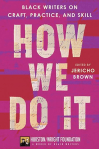


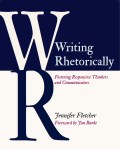
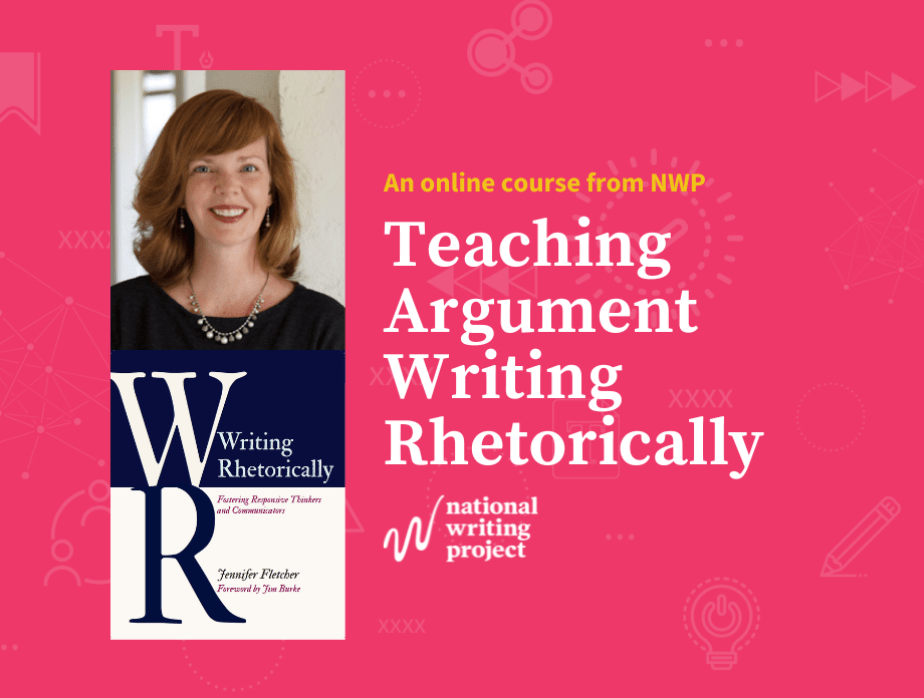












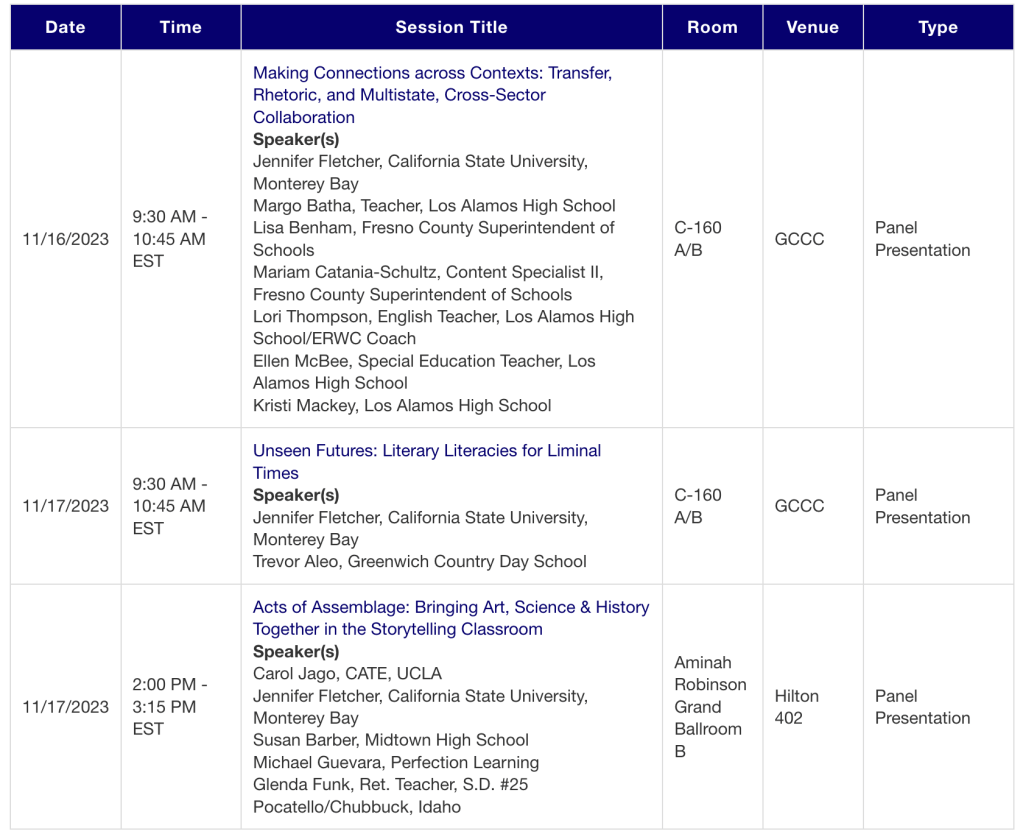


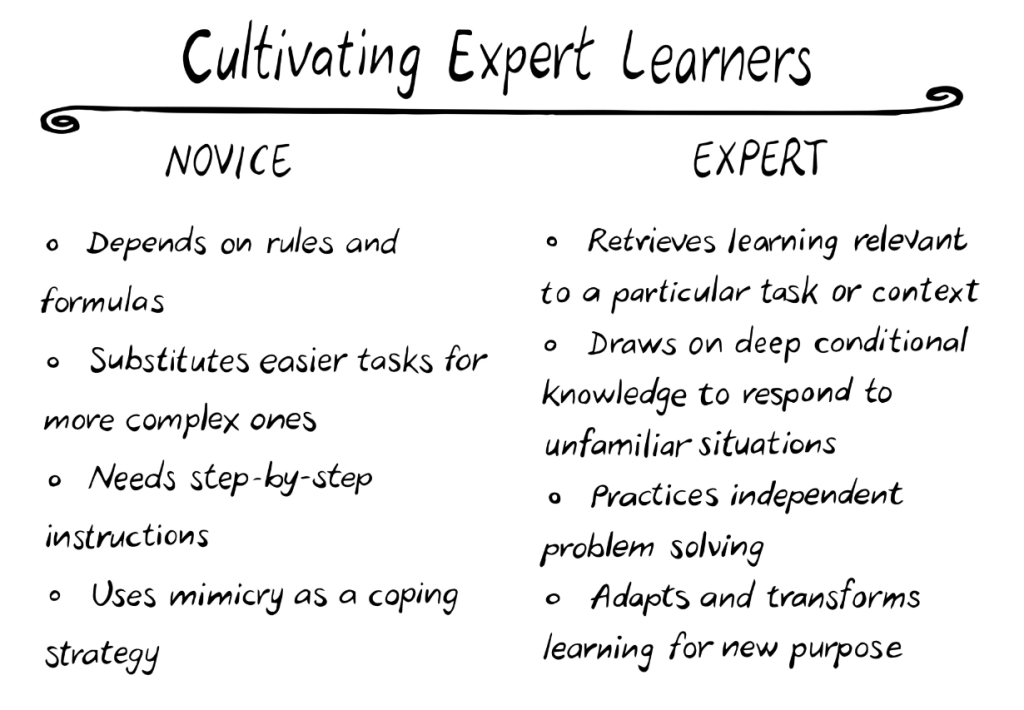

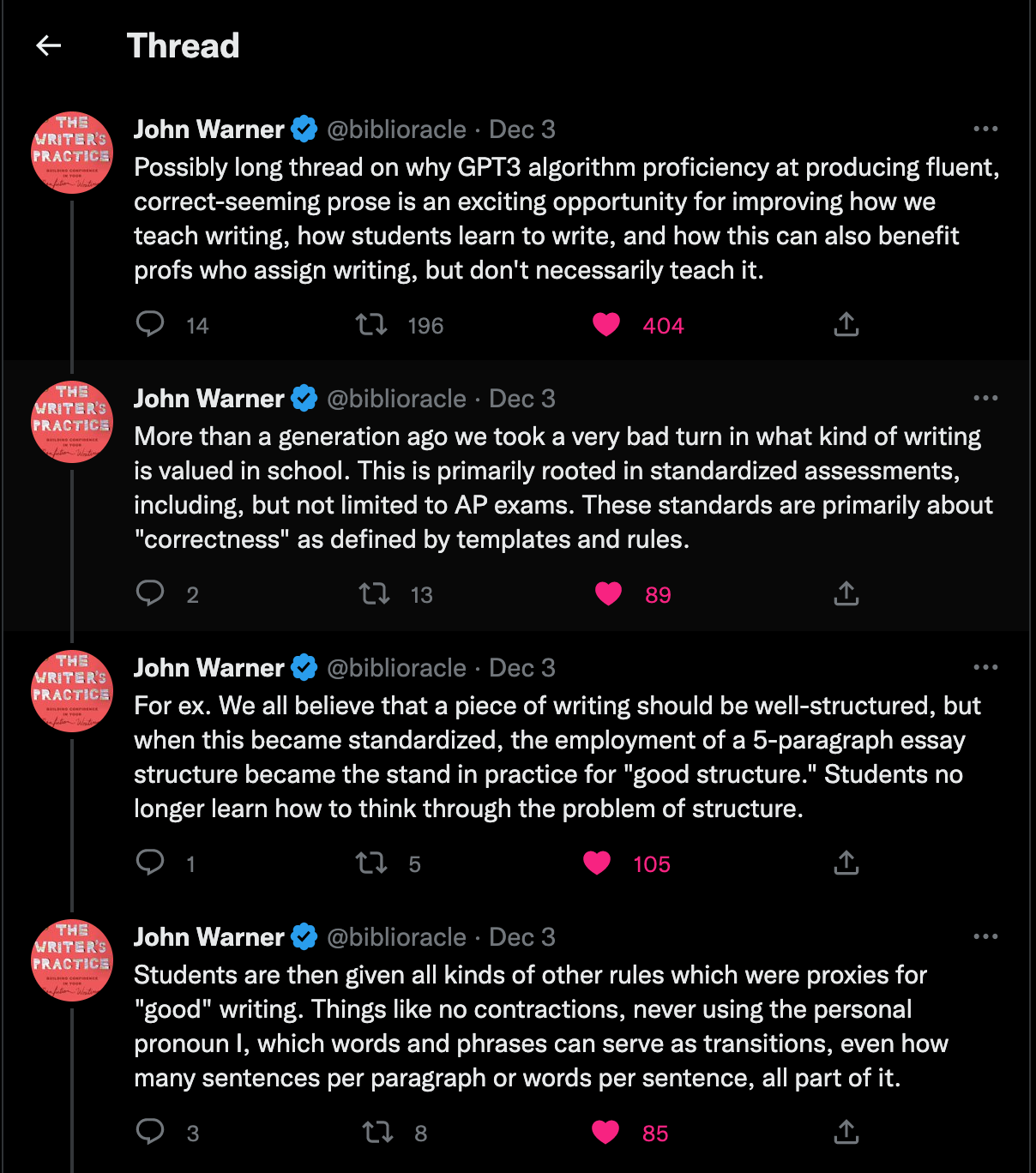
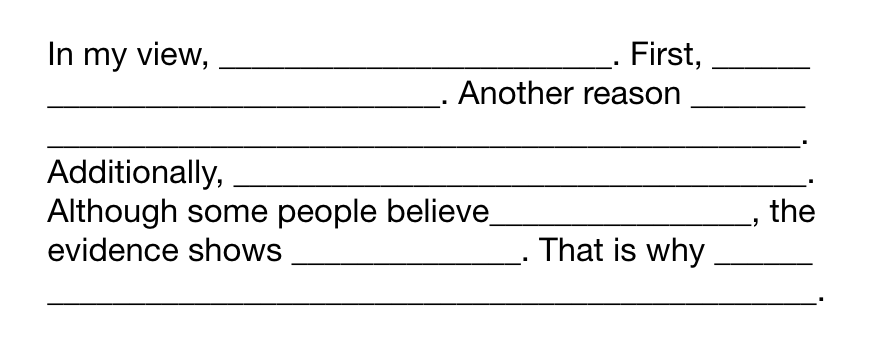



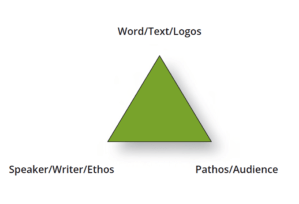




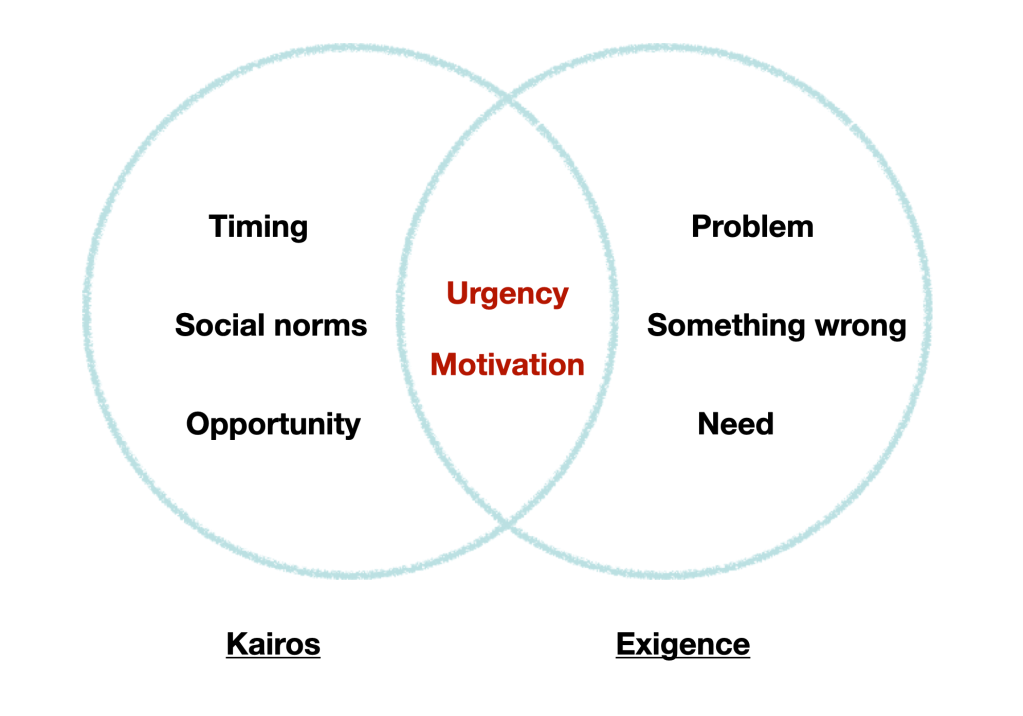
 Rhetorical Thinking


