
By Jennifer Fletcher I’m a big fan of home improvement shows: This Old House, Love It or List It, Good Bones–you name it, I’ve probably watched it. But my new favorite show is causing me to rethink the whole home makeover formula. Recently, I’ve been watching Cheap Irish Homes. This is the house hunting showContinue reading “Let Chaos Come”
Category Archives: Writing Rhetorically
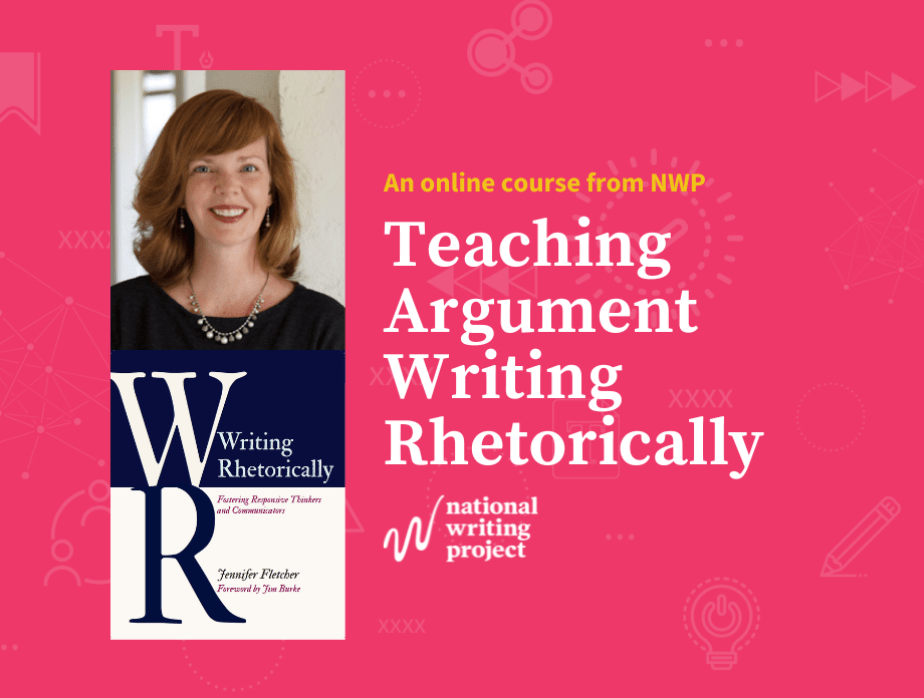
Teaching Argument Writing Rhetorically

Hi folks! This spring, I’m delighted to be facilitating an online course for The National Writing Project on teaching argument writing rhetorically. If this sounds like something that might interest you, please keep reading for the course description and schedule. Kind regards, Jennifer Fletcher Course Overview A rhetorical approach to argument writing cultivates adaptive, independentContinue reading “Teaching Argument Writing Rhetorically”
New NWP Online Course!
Reasoning Rhetorically in the Age of AI By Jennifer Fletcher What is human reasoning? What does it mean to be a human, reasoning? These are some of the questions participants will explore in an online course being offered this spring by the National Writing Project as part of its series on teaching argument writing. I’mContinue reading “New NWP Online Course!”
Developing Students’ Genre Awareness

By Jennifer Fletcher The first time I used an emoticon in a work email it just felt wrong. Years of being told to follow the “rules” of business communications—no exclamation points, nothing cutesy or personal—made that little smiley face seem like an act of rebellion. But I was far from being a rebel. The slang,Continue reading “Developing Students’ Genre Awareness”
Making the Most of the Opportune Moment

By Jennifer Fletcher In the novel The Hundred Secret Senses (1996), Amy Tan describes the sense of truth as a tingling along the back of the neck. I think of kairos the same way—a felt sense of truth to the moment. It’s that heightened awareness that helps us say the things that need to beContinue reading “Making the Most of the Opportune Moment”
Writing in the Presence of Others

By Jennifer Fletcher As a graduate student, I remember one of my advisors telling me that we’re all just adding our bricks to the wall. At the time, I couldn’t help hearing echoes of Pink Floyd, and I perhaps didn’t fully appreciate my advisor’s point about the collaborative nature of intellectual labor. After a coupleContinue reading “Writing in the Presence of Others”
Writing Thesis Statements as Enthymemes

By Jennifer Fletcher In my new book Writing Rhetorically, I share one of my favorite quotations from rhetoricians Edward P.J. Corbett and Rosa A. Eberly: “Reasoning, by itself, will not get the potatoes peeled” (1). It takes humans in communication with other humans to accomplish real work in the world. When we reason rhetorically, weContinue reading “Writing Thesis Statements as Enthymemes”
Diction Design

By Jennifer Fletcher Did you ever watch the television show Project Runway on Bravo? If so, do you remember the accessory wall with its array of shoes, belts, and handbags suitable for a variety of occasions? Style mentor Tim Gunn always encouraged the fashion designers competing on the show to use the range of available accessories “thoughtfully.” Writers also needContinue reading “Diction Design”
Resurrecting Dead Words

By Jennifer Fletcher In Teaching Arguments, I write about an activity I used for many years with my high school and college students: dead word funerals. I first learned about “dead words” when I was a student teacher back in the mid-nineties. At the time, it seemed like a clever and fun way to teachContinue reading “Resurrecting Dead Words”
Working the Problem: Rhetorical Thinking and the Design Process

By Jennifer Fletcher NOTE: This post first appeared on the Stenhouse Blog. What do you do when you don’t know what to do? This question has become a guiding line of inquiry in my work as a teacher these days. For both me and my students, the ability to respond effectively to novel challenges hasContinue reading “Working the Problem: Rhetorical Thinking and the Design Process”
 Rhetorical Thinking