Reasoning Rhetorically in the Age of AI

By Jennifer Fletcher
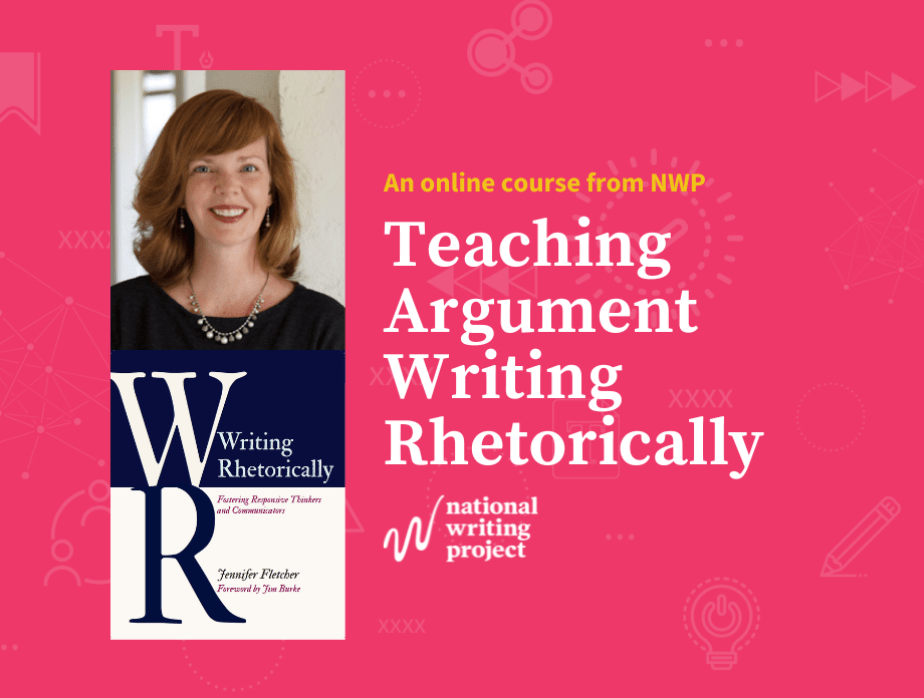
What is human reasoning? What does it mean to be a human, reasoning? These are some of the questions participants will explore in an online course being offered this spring by the National Writing Project as part of its series on teaching argument writing. I’m honored to be the course facilitator. The course–“Teaching Argument Writing Rhetorically“–runs from March to May and will examine principled approaches to argumentation in the age of AI.
I am not anti-AI (yet). I’m still learning to leverage the resources of AI in effective and ethical ways. But regardless of where I’ll land on the AI issue, I know this for sure: Human communication is now more important than ever. Our NWP spring course will focus on the uniquely human and critically important reasoning and communication skills that are enduringly relevant in our lives. For our students, these reasoning and communication skills are the gateways to the futures, communities, and relationships they want to build.
Fostering Agency, Not Artifice
Today’s Large Language Models (LLMs) are convention-enforcement machines. Chatbots are calibrated to what has already been done, not to what is possible. While a disruptive form of technology themselves, AI chatbots are not yet designed to disrupt language conventions or support linguistic innovation and diversity. Like other predictive or corrective language apps (e.g., autocorrect or spellcheck), chatbots can interfere with authentic communication by pressuring people to use artificial language that doesn’t come naturally to them and that may not represent their intended meaning.
Imagine if Shakespeare had to compose his plays in a word processing program that told him he was wrong every time he tried to introduce a neologism. If he was prone to self doubt (which seems unlikely), we probably wouldn’t have words such as “generous,” “amazement,” or “bedazzled” in the English language. Writers already have to battle our inner editors telling us we’re not good enough. Artificial intelligence that challenges writers’ word choices and ideas in the early stages of composition can significantly impair production and creativity.
Traditional instruction can also get in the way of students’ thinking and composing, particularly when it’s based on deficit views of learners or rigid rules for “good” writing. Like chatbots, one-size-fits all approaches to writing instruction can limit students’ options and force their compliance with Standardized English.
For these and many other reasons, I continue to see rhetorical thinking as the pathway to student agency and success so many of us are seeking. Rhetorical thinking is a method of humanistic inquiry that fosters agentive communication. With its heightened attention to changing social contexts, identities, and relationships, a rhetorical approach helps us center what it means to be a human, learner, and writer at this moment in history. Rhetorical thinking is thus a humanizing counter-method to formulaic approaches to writing–regardless of whether those formulas come from a bot or a worksheet.
(By the way, if you’re not yet following AI researcher Marc Watkins’s blog on Substack, you should be. Watkins, an Academic Innovation Fellow at the University of Mississippi, is one of the smartest and most nuanced thinkers on AI around. For a Luddite and slow learner like me, his blog posts are exactly the support I need to begin to grasp the scale and implications of the technological transformation we’re living through.)
Teaching Rhetoric, Not Rules
Instead of the prescriptive rules and formulas that increase students’ dependence on teachers or AI, our NWP course focuses on developing the rhetorical knowledge and skills that enable students to adapt and apply their literacy learning in new situations. It’s not my job, or a bot’s, to tell students what to write. It’s my job to help students learn to figure out how to take effective rhetorical action in diverse settings.
When we teach argument writing rhetorically, we empower students to make their own choices as thinkers and communicators. A rhetorical approach cultivates flexible, independent learners who can discover their own questions, design their own inquiry process, develop their own position and purposes, and contribute to conversations that matter to them.
The four-week course also provides strategies and frameworks for taking argument writing to the next level by developing students’ rhetorical problem-solving skills. These include the dialogic and interpersonal skills that help learners communicate and collaborate across contexts. I daily bump into reminders of how difficult communicating across our differences can be. “Understand before you argue” has become a guiding slogan in both my teaching and personal life. This is one of those areas where my practice can fall short of my aspirations, so I’m especially looking forward to hearing ideas from colleagues for promoting civil discourse and productive, student-led conversations.
Using examples from my book, Writing Rhetorically, participants in the course will examine and design instructional activities that foster inquiry-based argumentation and transferable literacy skills. Here’s a quick preview of some of my top picks:

- Reading with and against the grain (see my post on Peter Elbow’s believing game)
- Descriptive outlining (see my Says & Does Chart)
- Genre analysis
And because we can all use some extra processing time these days, we’ll be taking a six-week break between Session 1 and Session 2 of this course for folks to pilot the instructional strategies and reflect on their learning. During this hiatus, I’ll be available for one-on-one live coaching sessions (included in the course registration fee).
I hope you’ll consider joining us for this course as we share ways to deepen students’ understanding of how to analyze and compose arguments in diverse contexts for authentic human purposes. If you have any questions, please DM me @JenJFletcher or email me at Jfletcher@csumb.edu.
Jennifer Fletcher is a professor of English at California State University, Monterey Bay and a former high school teacher. She is the author of Teaching Arguments, Teaching Literature Rhetorically, and Writing Rhetorically.

NOTE: The registration fee for this course includes a print copy of Writing Rhetorically: Fostering Responsive Thinkers and Communicators (Stenhouse 2021).
What You Will Get:
- Four real-time virtual workshops
- A print copy of Writing Rhetorically: Fostering Responsive Thinkers and Communicators
- Digital study guide and appendixes for Writing Rhetorically and Teaching Arguments
- Activities and graphic organizers for teaching audience, purpose, genre, and structure
- Support for teaching evidence-based reasoning, synthesis, and claim development
- A digital badge indicating completion of 20 learning hours
- Option for 2 CEUs through CA State University, Monterey Bay for an additional cost.
Time Commitment
- This course will run for two weeks in March and two weeks in May:
- 1 hour of synchronous and four hours of self-paced learning per week for a total of 20 hours
- March 3 – 16, 2024
- Real-time events: March 6th and March 13, 4-5pm PT | 7-8pm ET
- May 5 – 18, 2024
- Real-time events: May 8th and 15th, 4-5pm PT | 7-8pm ET
For registration questions and payment options, email teachargument@nwp.org.
Register here. Please visit this link for more about courses offered by NWP.

 Rhetorical Thinking


