

By Jennifer Fletcher
In the novel The Hundred Secret Senses (1996), Amy Tan describes the sense of truth as a tingling along the back of the neck. I think of kairos the same way—a felt sense of truth to the moment. It’s that heightened awareness that helps us say the things that need to be said, that must be said, before it’s too late.
Kairos is a concept from classical rhetoric that can be defined as “the right words at the right time” or “the opportune moment.” The ancient Greeks had two conceptions of time: chronos and kairos. While chronos refers to quantitative or measurable time, kairos represents a sense of relational time. The right time for something depends on the thing’s relationship to other factors.

Kairotic awareness thus heightens our sense of the relative position of an issue, event, or opportunity in a specific context. Kairos also refers to the idea of “right measure.” We see this idea today when something is described as “too much” (i.e., overboard or cringy). The “wrong measure” is inappropriate for the circumstances.
Audience and Opportunity
Because of its attention to the immediate social situation of acts of communication—both in terms of what is possible (the opportunity) and appropriate (the decorum)–kairos is a performance booster. Often we only have one shot at convincing our audience, so our arguments have to be so compelling that they’re heard the first time. In these cases, it’s especially important that we keep our cool, that we are open-minded and discerning, so that we don’t get upset and blow our chance. Here’s where an internalized practice of playing the believe game (Elbow 255) is crucial. In those make-or-break moments, we need to be able to trust our training.
One of my students, for instance, created a PSA on the value of a college education to be shared during morning announcements over the loudspeaker. Knowing that this is a particularly tough gig—poor audio quality, inattentive students, lots of background chatter—my student worked to make his PSA as engaging and entertaining as possible.
Writing his message for a real rhetorical situation made all the difference. He knew he’d need to make some extra clever moves if he was going to succeed in capturing this resistant audience’s attention. The PSA would only be read once, so he’d have to make the most of this occasion.
We can deepen students’ responsiveness to their audience by asking them to think about kairos:
- What might the audience be feeling in that unique moment?
- What special circumstances need to be acknowledged? Is there “an elephant in the room”?
- How much time might the audience need to get used to a new idea or make a decision?
I use a graphic organizer to guide my students’ analysis of the kairos of rhetorical situations when they’re newer to this way of thinking. This kind of perspective shift deepens our empathy as writers by helping us to see the issue and situation from our audience’s point of view.
Being True to the Moment
When we develop students’ kairotic knowledge as part of a rhetorical approach to texts, we prepare them for the novel literacy demands of the postsecondary world by helping them optimize their available resources and opportunities. We also sensitize them to the type of truth Tan describes as a felt sense. Awareness of kairos acts as a gut check of the honesty and importance of our words.
I loved the definition one of my students gave for kairos: “the words that are said that leave you taken aback and leave you with a feeling of a burning passion or leave you humbled.” This is the kind of deep understanding that students carry with them into their future lives.
Honoring the Social Context
In Ancient Rhetorics for Contemporary Students, rhetoricians Sharon Crowley and Debra Hawhee explain how certain cultural experiences or historical events “open a kairotic moment” (48). A mass shooting, they note, intensifies discussion of gun control while making the topic especially urgent (48). A kairotic shift, or opening, also changes what can be said and done in a particular moment. The day of the Columbine shooting, Sandy Hook shooting, Parkland shooting, Uvalde shooting—and the many other tragic school shootings we’ve endured—were hard days to be a teacher. On such days, we stop everything we’re doing to respond to our students’ needs. We instinctively know that ploughing ahead with our lesson plans would be inappropriate, and even traumatizing, given the circumstances.
Kairos teaches us that we can’t just stick to the script and ignore what’s happening in the world around us. In his keynote address at the 2018 CATE Convention, Kelly Gallagher described how he abandoned his plan to start To Kill a Mockingbird in the wake of the shooting at Marjory Stoneman Douglas High School in South Florida that left 17 people dead. Gallagher said it seemed “frivolous” (March 10, 2017) to start Lee’s novel at that moment. So instead, he created a 14-day unit on what should be done to stop mass shootings. Kairotic teaching is responsive teaching.
Watching for Turning and Tipping Points
Awareness of kairos also helps us discern turns in the conversation. We’re on the watch for new arguments and new voices because we understand that the conversation is always changing. And if the kairotic moment doesn’t yet seem right for the issue we want to address, we look for a way to create an opening. Part of our skill set as rhetors is knowing how to shift our audience’s focus when needed.
For a good example of kairos in action, take a look at the following excerpt from an Associated Press article on “fake news.” You’ll see that there’s also a strong sense of exigence (a problem that prompts a response) in this piece:
“Spread of Fake News Prompts Literacy Efforts in Schools” Ryan J. Foley
Advocates say the K-12 curriculum has not kept pace with rapid changes in technology. Studies show many children spend hours every day online but struggle to comprehend the content that comes at them.
For years, they have pushed schools to incorporate media literacy — including the ability to evaluate and analyze sources of information — into lesson plans in civics, language arts, science and other subjects.
Their efforts started getting traction after the 2016 presidential election, which highlighted how even many adults can be fooled by false and misleading content peddled by agenda-driven domestic and foreign sources.
“Five years ago, it was difficult to get people to understand what we were doing and what we wanted to see happen in education and the skills students needed to learn,” said Michelle Ciulla Lipkin, executive director of the National Association for Media Literacy Education. “Now there is no question about the vitalness of this in classrooms.”
These are the kinds of turns in the conversation—and the openings—we want students to notice. Kairotic knowledge prepares students to recognize and adapt to change.



Connecting Kairos and Exigence
As the above excerpt shows, the Greek concept of kairos and the Roman concept of exigence are closely related. While these terms come from different social worlds and historical periods, they overlap in significant ways. I share the following Venn Diagram with my students and ask them about the similarities and differences between these concepts, an important practice for building conceptual frameworks as the authors of Learning That Transfers note. (See my previous post on analyzing conceptual relationships.)
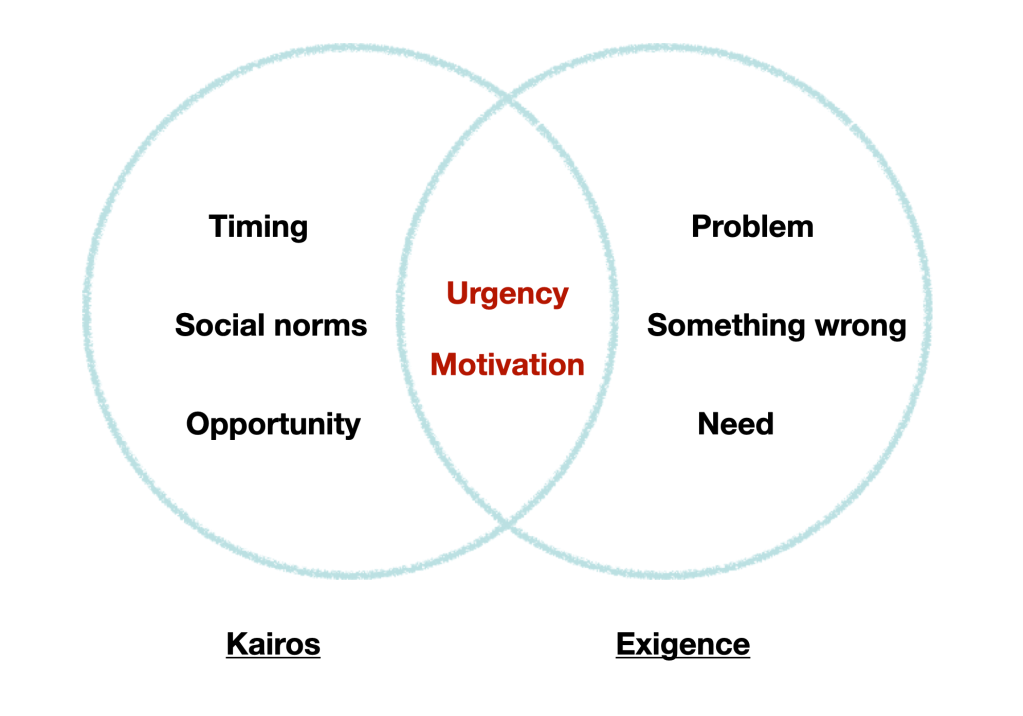
The combined power of this conceptual framework enhances students’ ability to take effective rhetorical action. This knowledge helps students think about the problems they want to address and the best times to act. (See my Planning Tool for Taking Rhetorical Action.)
Acknowledging the kairos of a rhetorical situation is a way of showing you’re paying attention. During the 2018 Golden Globes, for instance, Oprah Winfrey noted in her acceptance speech for the Cecile B. DeMille Award for Lifetime Achievement that “it is not lost on me that at this moment there are some little girls watching as I become the first black woman to be given this …award” (January 7, 2018, Beverly Hills, California). Winfrey’s words show she was fully aware of the special opportunity—and power—the televised event afforded her to positively impact girls of color.
Our students can learn from this kind of pro move by trying out similar language in their own writing:
- I have not forgotten…
- I am not unaware…
- I have not lost sight…
Kairos and Transfer
There’s an extra benefit to teaching the concept of kairos: it enhances students’ capacity to make meaningful connections. In Visible Literacy, Fisher, Frey, and Hattie write, “It should come as no surprise that a major condition for transfer to occur concerns relevancy. Learning becomes more meaningful when learners see what they’re learning as being meaningful in their own lives” (112). Seeing the relevance of the conversation they’re joining can also help them see the relevance of what they’re learning, which, in turn, makes them more likely to transfer their learning.
The Power of Kairos
Ultimately, kairotic knowledge boosts our control and confidence as writers, even when the mood or moment is inauspicious. Writers who are attuned to the nuances of timing know that they can use strategies such as a story or a style shift to change the vibe in a rhetorical situation. Anecdotes are moment makers. So are changes in style. For example, a sudden shift from academic to casual English can have the same impact as a speaker making a personally revealing aside during a formal presentation; it’s that moment when the speaker stops, takes a sip of water, removes their reading glasses and looks directly at the audience–and then says, “now let me tell you why this really matters…” And everyone leans in to listen.
Kairotic knowledge–and the in-the-moment responsiveness and resourceful it engenders–is a rhetorical superpower all students deserve to have.
Jennifer Fletcher is a professor of English at California State University, Monterey Bay and a former high school teacher. You can contact her at jfletcher@csumb.edu or on Twitter @JenJFletcher.
Works Cited
Crowley, Sharon, and Debra Hawhee. Ancient Rhetorics for Contemporary Students. 4th ed. Pearson Longman, 2009.
Elbow, Peter. Embracing Contraries: Explorations in Learning and Teaching. Oxford University Press, 1986.
Fisher, Douglas, Nancy Frey, and John Hattie. Visible Learning for Literacy: Implementing Practices that Work Best to Accelerate Student Learning. Corwin, 2016.

 Rhetorical Thinking

One thought on “Making the Most of the Opportune Moment”